AI estimate as of November 17, 2025 · verify with a professional before acting
AI-Generated · Verify before acting
Everything on this page is generated by AI for informational purposes only. AI can make mistakes — the AI may misidentify items or misattribute them (artist, maker, brand, designer, origin, era). This is not an official valuation and should not be used for insurance, sale, tax, estate, legal, or lending purposes — or any decision requiring a certified appraisal. It is not an authoritative claim about any person, brand, or rights holder — do not share or rely on it as a factual statement about a third party. Always consult qualified professionals before making financial decisions.
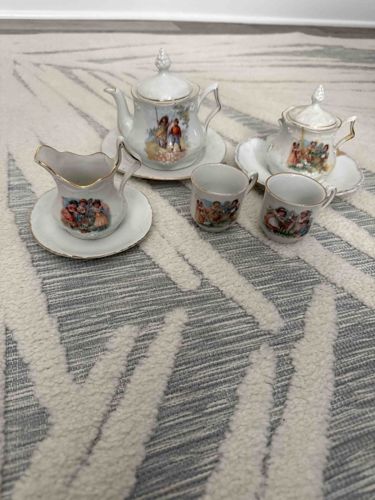
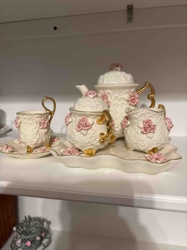
This is a miniature porcelain tea set, likely a toy or decorative item, comprising a teapot with lid, a sugar bowl with lid, a creamer, two teacups, and three saucers. Each piece is crafted from white porcelain, suggesting a fine ceramic material, and is adorned with intricate decals depicting romantic or pastoral scenes of figures in historical attire, possibly indicative of Rococo or Neoclassical romanticism. The primary colors in the decals are rich earth tones, blues, and reds, adding a touch of elegance to the small-scale pieces. All pieces feature delicate gold trim along the rims, handles, and spout, enhancing their decorative appeal. The teapot and sugar bowl lids are topped with decorative finials, adding to their ornate design. The handles of the teapot, sugar bowl, and creamer exhibit a curvaceous, almost rococo-inspired shape. The saucers have a subtle fluted or scalloped edge, providing a decorative border. The set appears to be in good overall condition, with no immediately visible chips, cracks, or significant wear to the gold trim, suggesting careful handling or display. There is no visible maker's mark or signature in the provided image. Given its delicate construction and thematic decoration, it likely dates from the late 19th to mid-20th century, common for such decorative or novelty porcelain sets. The craftsmanship appears to be of reasonable quality for a miniature set, with smooth glazes and neatly applied decals. The diminutive size indicates it is not for functional use with hot beverages but rather for display, doll play, or as a collectible.
AI Appraisal Report
This miniature porcelain tea set, featuring a teapot, sugar bowl, creamer, two cups, and three saucers, exhibits charming romantic scene decals and delicate gold trim. Based on the visual evidence, the condition appears to be very good, with no immediately apparent chips, cracks, or significant wear to the gold, which is commendable for such a delicate item. The craftsmanship, with smooth glazes and neatly applied decals, suggests a reasonable quality often seen in decorative or novelty sets from the late 19th to mid-20th century.
The market for miniature collectible tea sets is generally stable, driven by niche collectors of decorative arts and dolls' accessories. Comparable items of this size and decorative style, often unsigned, typically fetch values in the $60-$120 range, depending on the intricacy of the decals, condition, and completeness of the set. While not exceedingly rare, a complete set in excellent condition like this one does hold appeal. The romantic scenes and gold accents enhance its decorative appeal, contributing positively to its value within this segment. Factors impacting its value positively include its apparent excellent condition and the consistent decorative theme across all pieces.
It is important to note the limitations of an appraisal based solely on images. While the condition appears good, an in-person examination would be crucial to confirm the absence of hairline cracks, chips, rubbing to the gold trim, or repairs not visible in photographs. Without a maker's mark or provenance documentation, definitive attribution to a specific manufacturer or country of origin, which could significantly impact value for higher-end pieces, is not possible. Scientific testing is not typically required for items of this nature unless authenticity of material (e.g., bone china vs. standard porcelain) was a specific concern.