AI estimate as of September 18, 2025 · verify with a professional before acting
AI-Generated · Verify before acting
Everything on this page is generated by AI for informational purposes only. AI can make mistakes — the AI may misidentify items or misattribute them (artist, maker, brand, designer, origin, era). This is not an official valuation and should not be used for insurance, sale, tax, estate, legal, or lending purposes — or any decision requiring a certified appraisal. It is not an authoritative claim about any person, brand, or rights holder — do not share or rely on it as a factual statement about a third party. Always consult qualified professionals before making financial decisions.
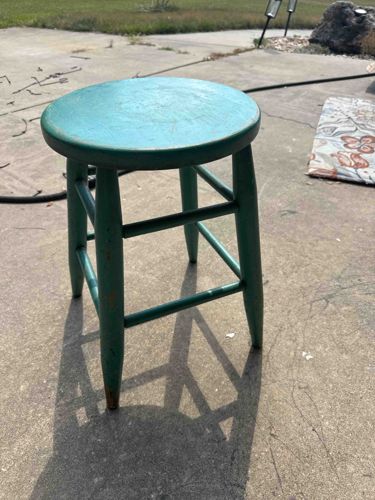
This is a vintage-style or possibly vintage wooden round stool, characterized by its vibrant teal-green or seafoam green painted finish. The stool features a circular, solid wooden seat with a slightly concave surface, measuring approximately 12-14 inches in diameter. The body of the stool is constructed with four sturdy, slightly tapered legs, which are reinforced by two sets of stretchers. The upper set of stretchers appears to be square or rectangular in cross-section, connecting the legs just below the seat, while a lower set, also likely square, provides additional stability closer to the ground. The construction suggests a simple, functional design, possibly assembled using dowels or mortise and tenon joints, though not explicitly visible. The entire piece is uniformly painted in the aforementioned teal-green hue, displaying significant wear and tear. There are numerous chips, scuffs, and areas where the paint has worn off, particularly along the edges of the seat and the lower sections of the legs, revealing what appears to be natural wood or a darker undercoat beneath. This distressed finish suggests regular use over time. The exposed wood appears to be a light-colored hardwood or softwood, typical of utilitarian furniture. There are no discernible maker's marks, signatures, or stamps visible in the provided image. The style is utilitarian, leaning towards a farmhouse or rustic aesthetic due to the painted finish and simple construction. Based on the visible wear and style, it could be estimated to be from the mid-20th century, though without further details, a precise age is difficult to determine. Its quality is good for a functional piece; the wear indicates durability despite aesthetic imperfections.
AI Appraisal Report
Upon visual examination of the Painted Wooden Round Stool, I observe a charming, utilitarian piece, likely dating from the mid-20th century. The vibrant teal-green painted finish, though significantly distressed with numerous chips and scuffs, contributes to its rustic or farmhouse aesthetic. The solid construction with four tapered legs and two sets of stretchers suggests durability, and the wear patterns on the paint reveal a piece that has seen regular use rather than abuse, which adds to its character. The exposed underlying wood appears to be a light-colored, common timber. Its condition, while showing significant paint loss, is consistent with its age and function; functionally, it appears sound, but aesthetically it falls into the 'shabby chic' or 'distressed vintage' category.
In terms of market conditions, similar vintage utilitarian stools, especially those with an attractive original paint color, often find buyers in the secondary market. Comparables for such items typically include general antique or vintage furniture stores, online marketplaces, and flea markets. Demand for simple, functional vintage stools remains steady, especially for decorative purposes or as accent pieces in rustic or eclectic interiors. Rarity is not a significant factor here; while unique in its specific wear patterns, the general form and construction are common. Factors impacting value include the appealing color, the genuine wear (as opposed to artificial distressing), and its functional integrity despite aesthetic imperfections.
It is crucial to note that my assessment is based solely on the provided image. Without an in-person examination, I cannot definitively determine the type of wood, the specific construction methods beyond visual inference, or whether the paint is original to the piece or a later application. Authenticity of age is estimated based on style and wear; a physical inspection would allow for testing of paint layers, examination of joinery, and potential discovery of obscured maker’s marks or manufacturing indicators.