AI estimate as of October 8, 2025 · verify with a professional before acting
AI-Generated · Verify before acting
Everything on this page is generated by AI for informational purposes only. AI can make mistakes — the AI may misidentify items or misattribute them (artist, maker, brand, designer, origin, era). This is not an official valuation and should not be used for insurance, sale, tax, estate, legal, or lending purposes — or any decision requiring a certified appraisal. It is not an authoritative claim about any person, brand, or rights holder — do not share or rely on it as a factual statement about a third party. Always consult qualified professionals before making financial decisions.
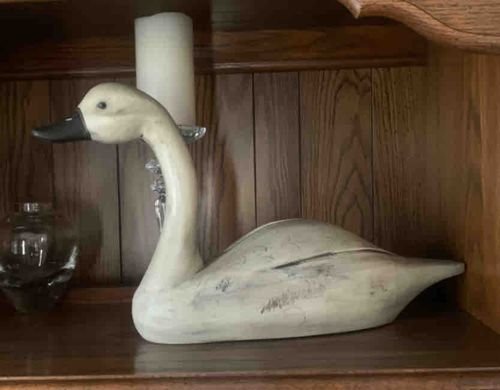
This item is a carved wooden swan, likely functioning as a decorative decoy or figurine. It features a predominantly off-white or cream-colored body with dark grey or black accents on the beak and eyes. The swan is depicted in a gracefully curved pose, with its long, slender neck arching upwards and then curving back towards its body, which rests flat as if floating on water. The carving exhibits a somewhat rustic or folk art style, indicated by the visible tool marks and the slightly uneven surface texture, which contributes to its aged appearance. There are noticeable dark streaks and areas of discoloration on the body, particularly on the lower central portion and along the top edge of the back, suggesting a distressed finish, intentional antiquing, or natural wear and patina over time. A prominent dark line or crack is visible across the back of the swan's body, which could be a natural fault in the wood, a separation due to age, or an intentional design element to mimic a feather line. The eyes are small, dark, and appear to be painted on, or possibly small inserted beads. The beak is realistically shaped and painted a solid, dark color, contrasting with the lighter head. The overall construction suggests it is carved from a single piece of wood for the main body and neck, though the beak detail might be added or further shaped. The item appears to be of a considerable size, suitable for display on a shelf or mantelpiece. Based on the style and apparent wear, it likely dates from the mid-20th century or later, embodying a classic Americana or hunting lodge aesthetic. The craftsmanship, while not exquisitely fine, reflects a skilled hand in capturing the essence of the swan.
AI Appraisal Report
Upon visual examination of the provided image, I assess this carved wooden swan as a decorative decoy or figurine, exhibiting characteristics of folk art. The condition appears consistent with age and use, displaying a distressed finish or natural wear, including dark streaks and discoloration, which contribute to its aged aesthetic. The prominent dark line across the back could be a natural wood imperfection, an age-related crack, or an intentional design element; this would require in-hand inspection to determine definitively. The craftsmanship, while not museum-grade, shows a skilled hand in capturing the swan's form. The visible tool marks are typical of folk art.
Market conditions for vintage wooden folk art and decorative decoys are generally stable, with demand driven by collectors of Americana, rustic decor, and specific bird-themed items. Comparables for similar mid-20th century carved wooden folk art pieces, particularly those with a strong decorative appeal and good condition, typically fall within the $150-$350 range. This item's appeal lies in its decorative quality and perceived age. Factors impacting value include the charming, if somewhat rustic, carving style and the appealing distressed finish.
Limitations in authenticity verification are significant based solely on images. Without physical inspection, I cannot confirm the wood type, exact construction methods (e.g., whether the beak is integrated or added), the nature of the dark line/crack (structural integrity vs. aesthetic choice), or the precise age. In-person examination would allow for tactile assessment of material, detailed inspection of tool marks, and confirmation of overall stability. Provenance documentation, though rare for such items, would also enhance authenticity, but is not typically expected for pieces of this value. Scientific testing for wood dating is not usually cost-effective for items in this price range.