These notes were written by the person who submitted this item. Appraiser.AI has not verified them, and the AI's identification and estimate may rely on them.
AI Estimated Value
Not an official valuation
$25-40
AI estimate as of November 10, 2025 · verify with a professional before acting
AI-Generated · Verify before acting
Everything on this page is generated by AI for informational purposes only. AI can make mistakes — the AI may misidentify items or misattribute them (artist, maker, brand, designer, origin, era). This is not an official valuation and should not be used for insurance, sale, tax, estate, legal, or lending purposes — or any decision requiring a certified appraisal. It is not an authoritative claim about any person, brand, or rights holder — do not share or rely on it as a factual statement about a third party. Always consult qualified professionals before making financial decisions.
This analysis also relies on unverified notes provided by the user, which may be incomplete or inaccurate and could affect the result.
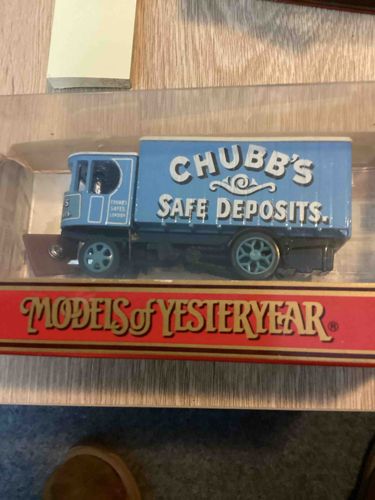
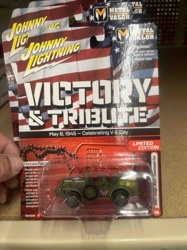
This item is a die-cast model of a 1929 Garrett Steam Wagon, part of the 'Models of Yesteryear' series, specifically model Y37. It is depicted in the livery of 'Chubb's Safe Deposits'. The model is predominantly light blue for the main body/cargo area and a darker blue or black for the chassis and cab roof, with lighter green wheels. The 'CHUBB'S SAFE DEPOSITS.' text is prominently displayed on the side of the cargo compartment in white, with a decorative flourish beneath 'CHUBB'S'. The cab features small windows and some painted details, including what appears to be 'No 5' on the side and 'THOMAS TAPES LONDON' in smaller text below it. The overall construction suggests a standard die-cast model, likely made of metal with some plastic components for details like windows or interior elements, if any are present. The model appears to be in excellent condition, still housed within its original display packaging, which is a clear plastic shell over a red cardboard base. The packaging itself shows the 'MODELS OF YESTERYEAR' logo in gold lettering on a red background. There are no visible signs of wear, damage, or repairs on the model itself, indicating it is well-preserved and possibly unused. The quality indicators point to a collectible-grade toy model, likely from the late 20th century, given the styling and packaging typical of Matchbox 'Models of Yesteryear' series. The attention to detail for the period-specific vehicle and company branding showcases good craftsmanship for a mass-produced collectible.
AI Appraisal Report
I have visually examined the provided image of the Matchbox Models of Yesteryear Y37 1929 Garrett Steam Wagon 'Chubb's Safe Deposits'. Based on this examination, the model appears to be in excellent, near-mint condition, still sealed within its original display packaging (clear plastic bubble on a red cardboard base). There are no visible signs of wear, damage, or repairs to the model itself, and the packaging also appears intact with the exception of potential minor shelf wear not discernible from the image. The colors are vibrant, and the decals are complete, indicating good preservation.
This is a standard mass-produced die-cast collectible from the Matchbox 'Models of Yesteryear' series, likely from the late 20th century. Authenticity, based on the visual cues of typical Matchbox branding and model details, appears consistent with known examples of the Y37. However, without a physical inspection, I cannot verify the exact materials, internal components, or confirm the absence of any subtle restorations or alterations that would not be visible in an image.
The market for 'Models of Yesteryear' is generally stable but not experiencing significant appreciation for common releases. While this model features a well-known British brand (Chubb's Safe Deposits), it is not considered exceptionally rare. Demand is primarily from collectors specializing in Matchbox, British commercial vehicles, or particular liveries. Comparable sales of Y37 models in similar condition and original packaging typically range from $25 to $40. Factors impacting this value include its pristine condition and original packaging, which adds a premium over loose examples.
Limitations: My assessment of authenticity relies solely on visual comparison to known examples. A full authentication would require in-hand inspection to verify weight, material consistency, scrutinize finer details for originality versus reproduction, and examine the integrity of the packaging seal. Provenance documentation (e.g., original purchase receipts) could also further solidify its history, but is not typically required for models in this price range.