AI estimate as of October 23, 2025 · verify with a professional before acting
AI-Generated · Verify before acting
Everything on this page is generated by AI for informational purposes only. AI can make mistakes — the AI may misidentify items or misattribute them (artist, maker, brand, designer, origin, era). This is not an official valuation and should not be used for insurance, sale, tax, estate, legal, or lending purposes — or any decision requiring a certified appraisal. It is not an authoritative claim about any person, brand, or rights holder — do not share or rely on it as a factual statement about a third party. Always consult qualified professionals before making financial decisions.
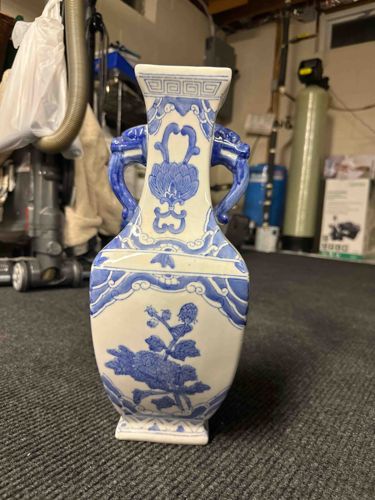
This item is a rectangular-bodied porcelain vase, primarily decorated in a classic blue and white underglaze style, often associated with Oriental ceramic traditions. The vase features a flared, rectangular mouth with a Greek key or 'leiwen' border pattern in blue. Below this, the neck narrows slightly, presenting a central blue floral or stylized lotus motif framed by swirling cloud-like patterns. The vase is equipped with two prominent, sculpted dragon-head handles on either side, painted in a contrasting solid blue, with the dragon's heads facing upwards towards the mouth. The body of the vase is essentially rectangular, tapering slightly towards a rectangular foot. Each of the four sides of the body is adorned with a large, elaborate blue floral design, possibly representing peonies or other stylized blossoms and foliage, set against the white porcelain ground. The base of the vase also has a patterned border resembling geometric or wave motifs. The construction appears to be molded porcelain, with a smooth, glazed finish. The colors are crisp, indicating good quality application of the cobalt blue pigment. Observable condition issues from the image are limited, but there appears to be some minor surface grime or dust, particularly around the recessed areas of the handles and patterns. There are no obvious chips, cracks, or repairs visible, suggesting it is in good overall condition. The style points towards an East Asian (likely Chinese) influence, possibly a decorative piece from the late 19th or 20th century, but without maker's marks or a view of the base, precise age and origin are difficult to confirm. The craftsmanship appears to be of decent quality, with detailed brushwork on the patterns and well-formed sculptural handles.
AI Appraisal Report
I have examined the provided image of this Blue and White Oriental Style Porcelain Vase with Dragon Handles. The item appears to be in good overall condition, with no visible chips, cracks, or repairs. Minor surface grime is noted, particularly around the intricate details, which is common and easily remedied. The underglaze blue decoration, including the 'leiwen' border, floral motifs, and detailed dragon handles, suggests decent quality craftsmanship and crisp color application. This style is characteristic of East Asian ceramics, likely Chinese, produced for decorative purposes.
Authenticity, in terms of age and origin, is difficult to confirm solely from an image. While the style points to a late 19th or 20th-century decorative piece, without clearer views of the base, potential maker's marks, or a physical inspection, a precise attribution is not possible. The piece does not exhibit the characteristics of extremely rare or ancient imperial porcelain, which would command significantly higher values. Instead, it aligns with a category of mass-produced or studio ceramics that are widely available.
Market conditions for such decorative blue and white porcelain are generally steady but not booming. Comparables include similar-sized decorative Oriental-style vases found in antique malls, online marketplaces, and estate sales. Demand is moderate, appealing to collectors of chinoiserie or those seeking decorative accents. Rarity is not a significant factor here; while unique in its specific design, the general category is common. Factors impacting value are primarily its decorative appeal and good condition. The lack of definitive age, provenance, or significant maker's marks limits its upper value.
For full authentication, an in-person examination would be critical to assess the porcelain body, glaze, and decoration more closely, including the presence and nature of any base marks. Scientific testing (e.g., thermoluminescence) could provide an accurate age, but this is usually reserved for items with higher potential value. Without such verification, this piece is appraised as a decorative item of good quality.