AI estimate as of July 31, 2025 · verify with a professional before acting
AI-Generated · Verify before acting
Everything on this page is generated by AI for informational purposes only. AI can make mistakes — the AI may misidentify items or misattribute them (artist, maker, brand, designer, origin, era). This is not an official valuation and should not be used for insurance, sale, tax, estate, legal, or lending purposes — or any decision requiring a certified appraisal. It is not an authoritative claim about any person, brand, or rights holder — do not share or rely on it as a factual statement about a third party. Always consult qualified professionals before making financial decisions.
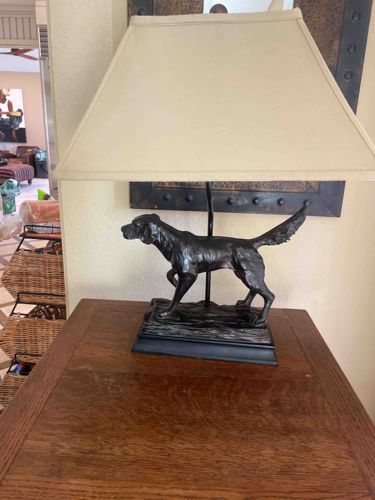
The item is a table lamp featuring a solid, dark-patinated bronze sculpture of a dog, likely a hunting dog like a Setter or Pointer, in a 'pointing' stance. The dog is finely detailed, showing musculature, fur texture, and an alert posture with one front paw raised and tail extended. It stands on a textured base, possibly depicting terrain or a log, which is then affixed to a rectangular stepped plinth. The lamp column emerges subtly from behind the dog sculpture. The overall color is a deep, rich brown to black, characteristic of aged bronze with an antiqued finish. The lampshade is a classic tapered rectangular or slightly trapezoidal shape, made of a light, neutral-colored fabric, possibly linen or silk, with visible piping along the edges, suggesting a traditional design. The hardware connecting the shade to the lamp base appears to be dark metal, matching the bronze. The base itself seems robust and stable. There are no obvious signs of significant damage like breaks or large dents, but the patina on the bronze suggests minor wear consistent with age and handling, adding to its character. The craftsmanship appears to be of good quality, with attention to detail in the animal's anatomy and stance. This style of lamp, incorporating animal sculptures, was popular in the late 19th to mid-20th century, particularly within hunting or equestrian-themed decor, and this specific piece likely dates from that period or is a later reproduction in a similar style.
AI Appraisal Report
Based on my visual examination of the Bronze Dog Sculpture Table Lamp, I assess its condition to be very good, consistent with age. The dark patina on the bronze dog sculpture, which appears to be a hunting dog in a pointing stance, shows minor wear but no significant damage like breaks or large dents. This wear contributes to its authentic aged character. The craftsmanship is high quality, with fine detailing in the dog's anatomy and fur texture, suggesting a well-made piece. The lampshade complements the traditional design, and the overall aesthetic points to a piece from the late 19th to mid-20th century, a period when such animal-themed lamps were popular in sporting decor.
In terms of market conditions, bronze animal sculptures and lamps with an antiqued finish are consistently in demand, especially those depicting popular dog breeds or hunting themes. Comparable sales of similar quality bronze animal lamps or sculptures, particularly from the early to mid-20th century, typically range from $400 to $900 depending on size, artistry, and provenance. The piece's apparent solidity and fine detail enhance its desirability. Its presumed rarity is moderate; while animal-themed lamps are not unique, this specific quality and design contribute to its appeal to collectors of sporting art or vintage lighting.
Factors significantly impacting value include the quality of the bronze casting and finish, the intrinsic artistic merit of the dog sculpture, and its functional integrity as a lamp. Its condition, as observed, is a strong positive.
It is important to note the limitations of an appraisal based solely on images. While the piece appears authentic to its stylistic period, a definitive authenticity verification would require in-person examination to assess the bronze's composition, casting method, and true patina. Physical inspection would also allow for an assessment of the lamp's wiring for safety and functionality. Provenance documentation, if available, would provide concrete evidence of its origin and history, further solidifying its value. Scientific testing, such as XRF analysis for alloy composition, could also confirm authenticity and age. Without these, I can only assess based on visual characteristics.