AI estimate as of July 31, 2025 · verify with a professional before acting
AI-Generated · Verify before acting
Everything on this page is generated by AI for informational purposes only. AI can make mistakes — the AI may misidentify items or misattribute them (artist, maker, brand, designer, origin, era). This is not an official valuation and should not be used for insurance, sale, tax, estate, legal, or lending purposes — or any decision requiring a certified appraisal. It is not an authoritative claim about any person, brand, or rights holder — do not share or rely on it as a factual statement about a third party. Always consult qualified professionals before making financial decisions.
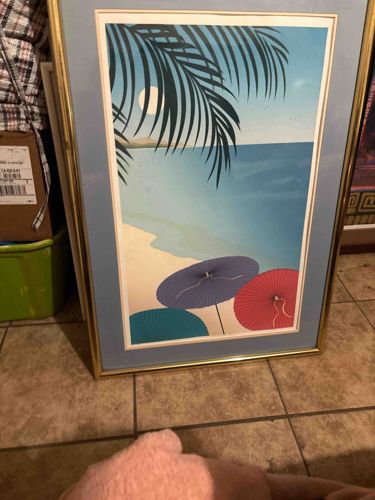
This item is a framed print depicting a stylized beach scene, likely from the late 20th century, possibly 1980s or 1990s, given the artistic style. The print features a serene coastal landscape with distinct blocks of color. In the foreground, a sandy beach is visible, leading to a calm blue ocean, which transitions to a lighter blue sky near the horizon. Overhanging from the upper left, a large, dark green palm frond is prominent, partially obscuring a white, full-moon-like orb in the sky, which could also represent a bright sun. On the beach, there are three colorful, open beach umbrellas: one is a shade of purple/blue, one is red, and the third, partially obscured on the left, is teal. The print is matted with a light blue mat board, and the entire piece is housed within a simple, gold-toned metallic frame. The frame appears to be made of a thin metal or a material with a metallic finish, with a slightly reflective surface. There are no visible condition issues on the print itself, such as fading, tears, or significant marks. The mat board also appears clean and well-preserved. The frame, however, shows some signs of wear typical for its age, including minor scuffs or scratches consistent with general handling and storage, though no major damage like dents or bends are immediately apparent. No specific artist's signature, title, or edition number is visible in the provided image. The overall impression is one of a decorative, ready-to-hang piece of wall art designed to evoke a relaxing, tropical atmosphere.
AI Appraisal Report
I have examined the provided image of the framed beach scene print with palm frond and umbrellas. Based on visual assessment, the print itself appears to be in excellent condition, showing no apparent fading, tears, or significant marks. The mat board is also clean and well-preserved. The gold-toned metallic frame shows minor scuffs or scratches consistent with age and handling, but no major damage is evident. This suggests overall good condition for a decorative art piece of its likely vintage.
From the image alone, authenticity cannot be definitively determined. Without a visible artist's signature, title, or edition number, and lacking any provenance documentation, it's impossible to confirm the artist or specific print run. Factors significantly impacting value include the print's decorative nature and its lack of identifiable artist or provenance. This is a mass-produced decorative print, not an original artwork or a limited-edition print by a recognized artist, which limits its intrinsic value.
Market conditions for such decorative art are stable but low. Similar framed prints from the late 20th century, often found in retail home décor stores or discount outlets, typically sell in the secondary market for modest sums. Demand for generic decorative prints is consistent but rarely commands high prices, particularly for unauthenticated pieces. Rarity is low as such prints were widely produced. Comparables would include other framed decorative prints of similar size and subject matter found in online marketplaces, thrift stores, or estate sales.
For full authentication and to ascertain any potential for higher value, an in-person examination would be required to look for hidden signatures, edition numbers, or publisher marks not visible in the image. Furthermore, provenance documentation detailing its history of ownership and acquisition by a known gallery or artist would be crucial. Scientific testing, like examining print materials or ink composition, could also verify age but would not significantly impact the value of a mass-produced decorative item without known artistic attribution.