AI estimate as of July 26, 2025 · verify with a professional before acting
AI-Generated · Verify before acting
Everything on this page is generated by AI for informational purposes only. AI can make mistakes — the AI may misidentify items or misattribute them (artist, maker, brand, designer, origin, era). This is not an official valuation and should not be used for insurance, sale, tax, estate, legal, or lending purposes — or any decision requiring a certified appraisal. It is not an authoritative claim about any person, brand, or rights holder — do not share or rely on it as a factual statement about a third party. Always consult qualified professionals before making financial decisions.
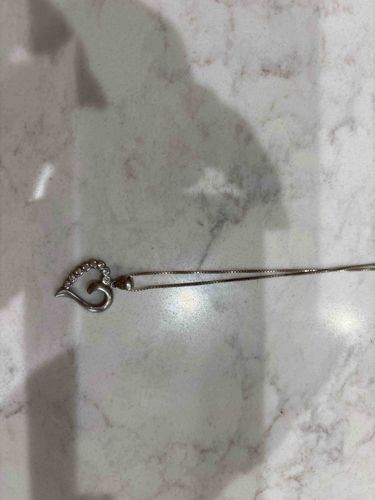
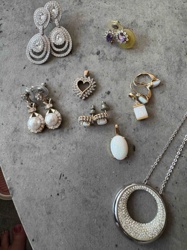
This item is a heart-shaped pendant necklace, likely crafted from white gold, sterling silver, or a similar silver-toned metal, given its metallic sheen. The pendant forms an open heart shape, with the upper portion of the heart adorned with a row of small, round, brilliant-cut stones, which appear to be diamonds or diamond simulants, set closely together in a pave or channel setting. There are approximately 8-10 visible stones, contributing to a sparkling effect. The metal throughout the heart pendant has a polished finish. The pendant is attached to a fine box chain, a type of chain characterized by square or box-shaped links that are interlocked to form a smooth, continuous line. The chain appears delicate and proportionate to the size of the pendant. No discernible maker's marks or stamps are visible in the provided image, so the manufacturer and exact metal purity cannot be confirmed without further inspection. The overall condition appears good, with no obvious signs of significant damage, such as bent components, missing stones, or severe scratches. There might be some minor surface wear consistent with general use, such as light scuffs or slight tarnishing on the metal, which is common for older pieces or those not regularly cleaned. The design is classic and timeless, suggesting it could be from the late 20th century or early 21st century, falling into a contemporary or modern style period. The craftsmanship appears to be decent, with the stones uniformly set, indicating a standard level of quality for mass-produced or semi-custom jewelry. The bail connecting the pendant to the chain seems sturdy.
AI Appraisal Report
Upon visual examination of the provided image, this heart-shaped pendant necklace appears to be in good overall condition. There are no obvious signs of significant damage such as bent components, missing stones, or severe scratches. Minor surface wear, consistent with general use, is anticipated but not clearly discernible from the image. Based on the metallic sheen, the metal is likely white gold, sterling silver, or a similar silver-toned alloy. The stones, approximately 8-10 in number, are small, round brilliant-cut, and appear to be either diamonds or diamond simulants set in a pave or channel setting, contributing to a sparkling effect. Without in-person inspection or specific markings, authenticity of diamond vs. simulant cannot be confirmed from the image alone. Similarly, the exact metal purity and type remain unverified without physical examination or discernible hallmarks.
Market conditions for similar pre-owned heart pendant necklaces in good condition, crafted from sterling silver with cubic zirconia or low-grade diamonds, typically range from modest to moderate. Demand for classic, versatile jewelry designs like this remains steady. However, the specific value is highly dependent on the stone type and quality, as well as the metal.
The most significant factors impacting value are the composition of the stones and the metal. If the stones are genuine diamonds and the metal is white gold, the value would be substantially higher. Conversely, if they are simulants and sterling silver, the value would be at the lower end of the spectrum. The absence of visible maker's marks or stamps also limits definitive authentication and can reduce estimable value. For full authentication and a precise valuation, an in-person examination is crucial to test the metal for purity, verify the stones using gemological tools (e.g., thermal conductivity or spectrographic analysis), and identify any hidden hallmarks. Provenance documentation, if available, would also aid in confirming authenticity and history.