AI estimate as of August 1, 2025 · verify with a professional before acting
AI-Generated · Verify before acting
Everything on this page is generated by AI for informational purposes only. AI can make mistakes — the AI may misidentify items or misattribute them (artist, maker, brand, designer, origin, era). This is not an official valuation and should not be used for insurance, sale, tax, estate, legal, or lending purposes — or any decision requiring a certified appraisal. It is not an authoritative claim about any person, brand, or rights holder — do not share or rely on it as a factual statement about a third party. Always consult qualified professionals before making financial decisions.
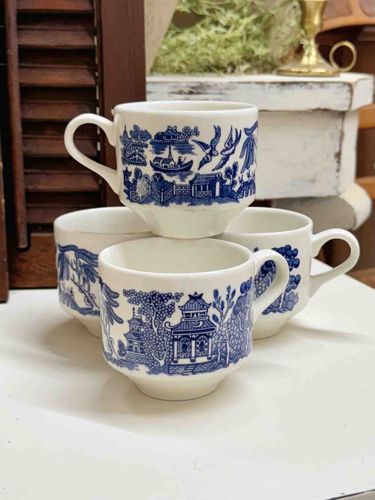
This set consists of four small ceramic cups, likely teacups or coffee cups, featuring the iconic 'Willow Pattern' design. Each cup is made of white ceramic with an underglaze transfer print in a vibrant cobalt blue. The Willow Pattern typically depicts a narrative scene with a bridge, pagoda, willow tree, peach tree, a boat, and flying doves or swallows, all of which are clearly visible across these cups. Two main variations of the scene are discernible among the visible cups: one highlights the boat with figures and flying birds, while the other features prominent pagodas and trees. The cups have a classic handle design, suitable for holding. Their construction appears sturdy, suggesting they might be diner-ware or a robust household set. While no significant damage such as chips or cracks are immediately apparent, a slight, even patina or subtle signs of use consistent with their age might be present. The specific size is difficult to ascertain without a reference, but they appear to be standard teacup or demitasse size. There are no visible maker's marks, signatures, or stamps in the provided images, which would be crucial for determining the exact manufacturer and age. However, given the ubiquity of the Willow Pattern, these cups could range in age from the late 19th century through the mid-20th century. The quality of the transfer print appears consistent and well-applied, indicating good craftsmanship, with no obvious blurring or fading of the intricate details.
AI Appraisal Report
Upon my virtual examination of this set of four Blue Willow Pattern ceramic cups, I can assess their condition and authenticity to a certain extent. Visually, the cups appear to be in good overall condition, with no immediate indications of chips, cracks, or significant wear. The underglaze transfer print of the iconic Willow Pattern is distinct and well-applied, showing good craftsmanship. The variations in the scene, while typical for ceramic transfers, do not detract from their appeal.
Market conditions for common Blue Willow pattern dinnerware are generally stable but not highly lucrative. This pattern has been mass-produced by numerous manufacturers for over a century, making individual pieces less rare unless they are from a highly sought-after producer or represent an unusual form. Comparables in the market for similar cups, especially unsigned ones, typically fetch modest prices. There's a consistent, albeit low, demand for everyday vintage tableware like this, often driven by collectors looking to complete sets or individuals seeking a decorative, traditional aesthetic.
The primary factor impacting value is the lack of visible maker's marks, signatures, or stamps. Without these, it's impossible to definitively attribute the cups to a specific manufacturer, which significantly limits their potential collectible value. While their age could range from the late 19th to mid-20th century, confirming this without physical examination is difficult. The presumed sturdy construction suggests they were intended for daily use rather than high-end decorative display, further impacting their valuation.
Limitations in authenticity verification are significant based on images alone. A physical inspection would be crucial to detect subtle hairline cracks, crazing, or repairs that are not visible in photographs. Furthermore, handling the cups would allow for an assessment of their weight, glaze quality, and overall feel, which can sometimes hint at their age and origin. For full authentication and a more precise dating, an in-person examination for maker's marks (even subtle impressions or glazes over stamps) and, if necessary, provenance documentation would be essential. Scientific testing would not typically be warranted for common ceramic items of this type unless there was an extraordinary claim of rarity or age.