AI Appraisal Estimate

AI-generated estimates · not official valuations

From the user

What was submitted

Photo and notes provided by the user — not generated by AI

Submitted item photo
Submitted photo · June 25, 2026

User's notes

No additional notes provided.

AI analysis below

AI appraisal

AI analysis & estimate

AI-Generated · Verify before acting

Everything below is generated by AI for informational purposes only. AI can make mistakes — the AI may misidentify items or misattribute them (artist, maker, brand, designer, origin, era). This is not an official valuation and should not be used for insurance, sale, tax, estate, legal, or lending purposes — or any decision requiring a certified appraisal. It is not an authoritative claim about any person, brand, or rights holder — do not share or rely on it as a factual statement about a third party. Always consult qualified professionals before making financial decisions.

Read the full disclaimer

AI Identification

·Not independently authenticated·Verify before acting

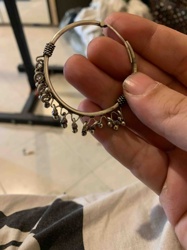
Tibetan/Himalayan Style Mixed Metal Cuff Bracelet

Ethnic Jewelry / Fashion Accessories

AI Estimated Value

·Not an official valuation·Verify before acting

$45–$85

As of June 25, 2026

AI Item Analysis

·AI can make mistakes·Verify before acting
This item is a handcrafted cuff-style bracelet, likely of Tibetan or Himalayan origin, featuring a mixed metal construction primarily of a copper-toned base. The bracelet is designed with an open-back adjustable cuff architecture. The most prominent decorative feature is the elaborate terminal ends, which are square-shaped panels containing intricate filigree or repoussé work. Within these panels, there is a distinct contrast between the base metal and what appears to be green-colored stones or enamel backgrounds, punctuated by small red cabochons (possibly coral or glass) set in the center. The band itself is smooth with raised bordering edges. In terms of condition, the piece shows a significant aged patina with dark surface oxidation, particularly in the recessed areas of the ornate ends, which is typical for vintage ethnic jewelry. The construction suggests a traditional folk-art style rather than high-end fine jewelry, often associated with the mid-20th century to modern souvenir trade. There are no visible maker's marks or purity stamps in the provided image. The overall craftsmanship displays the artisanal irregularities often found in hand-wrought copper and brass alloys from Central Asian jewelry traditions.
AI Appraisal Report

·AI can make mistakes·Verify before acting
I have conducted a visual analysis of this Tibetan/Himalayan style mixed metal cuff. The piece exhibits characteristic traits of mid-to-late 20th-century Himalayan export or souvenir jewelry. The base appears to be a copper-brass alloy, utilizing traditional filigree and repoussé techniques. The red cabochons are likely dyed sponge coral or glass, and the green backgrounds appear to be crushed stone paste or enamel rather than high-grade turquoise. The heavy patina and oxidation visible in the recessed decorative terminals suggest a vintage age, though this is common for pieces intended for the tourist trade to simulate antiquity. The current market for ethnic fashion accessories is stable but saturated with similar mixed-metal examples. Comparable pieces frequently sell in the $30 to $100 range at boutique ethnic shops or online marketplaces. Its value is driven primarily by its aesthetic appeal as a statement accessory rather than intrinsic metal value or historical rarity. The lack of hallmarking and the artisanal irregularities indicate folk-art production. Critically, this appraisal is based solely on digital images. A definitive valuation is limited by the inability to perform a streak test for metal purity or a thermal conductivity test on the inset stones. To confirm authenticity and refine this estimate, an in-person examination is required to check for 'cold-to-the-touch' properties of the stones and to verify if the patina is natural or chemically induced. Provenance documentation regarding the specific region of origin (e.g., Nepal vs. Tibet) would also clarify its historical context.

Get your items appraised

Instant estimates of your treasures with AI-powered appraisals

Browse More Appraisals