AI Appraisal Estimate

AI-generated estimates · not official valuations

From the user

What was submitted

Photo and notes provided by the user — not generated by AI

Submitted item photo
Submitted photo · June 1, 2026

User's notes

Made in Japan

AI analysis below

AI appraisal

AI analysis & estimate

AI-Generated · Verify before acting

Everything below is generated by AI for informational purposes only. AI can make mistakes — the AI may misidentify items or misattribute them (artist, maker, brand, designer, origin, era). This is not an official valuation and should not be used for insurance, sale, tax, estate, legal, or lending purposes — or any decision requiring a certified appraisal. It is not an authoritative claim about any person, brand, or rights holder — do not share or rely on it as a factual statement about a third party. Always consult qualified professionals before making financial decisions.

Note

This analysis also relies on unverified notes provided by the user, which may be incomplete or inaccurate and could affect the result.

Read the full disclaimer

AI Identification

·Not independently authenticated·Verify before acting

Japanese Hand-Painted Ceramic Pitcher

Ceramic or Pottery Pitcher

AI Estimated Value

·Not an official valuation·Verify before acting

$25 - $45

As of June 1, 2026

AI Item Analysis

·AI can make mistakes·Verify before acting
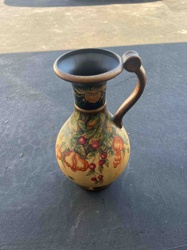
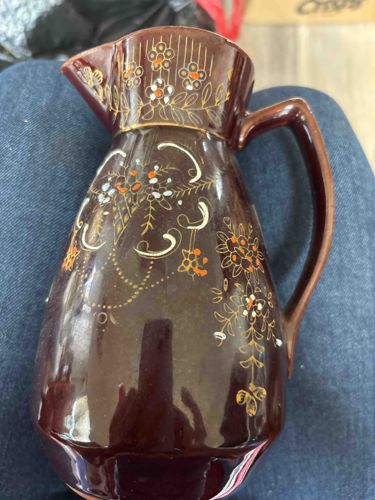
This is a vintage ceramic or pottery pitcher, likely from the mid-20th century, characterized by its rich, dark brown glaze. Its shape is a classic jug-style, featuring a wide base that tapers upwards to a narrower neck and a functional pouring spout. A sturdy handle is attached to the side, maintaining the dark brown color of the body. The most striking element is the hand-painted floral and scrollwork decoration that adorns the upper half and cascades down the body. The decoration primarily uses gold or brass-colored outlines for intricate leaves and vines, accented with small, stylized flowers in white and orange. The design also incorporates dotted lines and swirling motifs that suggest a level of delicate craftsmanship. The glaze appears consistent, with a high gloss finish that reflects light, indicating good preservation. There are no immediately visible chips, cracks, or significant wear beyond what might be considered typical for an item of its age, such as potential minor surface abrasions or slight loss of paint in some areas if closely inspected. The craftsmanship suggests it was mass-produced but with hand-finished decorative elements, a common practice for export wares from Japan during that period. The 'Made in Japan' context hints at a post-WWII to mid-century origin, typical for decorative household items exported globally. The overall impression is one of durability and decorative appeal, suggesting it was used as both a functional item and an ornamental piece.
AI Appraisal Report

·AI can make mistakes·Verify before acting
Upon examining the provided image and details, I have assessed this Japanese hand-painted ceramic pitcher. The item is consistent with mid-20th century decorative export ware, likely from the post-WWII era, as indicated by the 'Made in Japan' marking, dark brown glaze, and hand-applied gold, white, and orange moriage-style accents. The pitcher appears to be in good vintage condition, with the glossy glaze intact and no visible chips or cracks. The hand-painted details seem well-preserved, which is a positive value factor. These pitchers were mass-produced for the export market but featured hand finishing, making each piece unique. Their primary value is decorative rather than historical or as fine art. Market analysis of comparable items—mass-produced, hand-decorated Japanese ceramic pitchers from the mid-20th century—shows a relatively modest but steady demand among collectors of vintage decor and Japanese export ware. The value is primarily driven by aesthetic appeal and condition rather than rarity. While charming, these items are not exceptionally rare. It is important to note that this appraisal is based solely on digital images. A definitive assessment of authenticity and condition requires an in-person examination to check for maker's marks, hairline cracks, repairs, or wear to the paint that may not be visible in photos. Full authentication would benefit from physical inspection to confirm the clay body and glaze composition typical of the period.

Get your items appraised

Instant estimates of your treasures with AI-powered appraisals

Browse More Appraisals