These notes were written by the person who submitted this item. Appraiser.AI has not verified them, and the AI's identification and estimate may rely on them.
AI Estimated Value
Not an official valuation
$600-900
AI estimate as of November 2, 2025 · verify with a professional before acting
AI-Generated · Verify before acting
Everything on this page is generated by AI for informational purposes only. AI can make mistakes — the AI may misidentify items or misattribute them (artist, maker, brand, designer, origin, era). This is not an official valuation and should not be used for insurance, sale, tax, estate, legal, or lending purposes — or any decision requiring a certified appraisal. It is not an authoritative claim about any person, brand, or rights holder — do not share or rely on it as a factual statement about a third party. Always consult qualified professionals before making financial decisions.
This analysis also relies on unverified notes provided by the user, which may be incomplete or inaccurate and could affect the result.
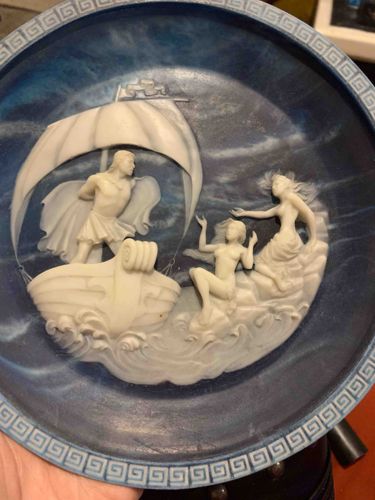
This item is a circular decorative plate, likely made of Wedgwood's distinctive jasperware, characterized by its matte, unglazed ceramic body. The dominant color scheme is a deep, variegated blue, reminiscent of ocean waves, with applied white bas-relief figures. The central design depicts a classical mythological scene featuring a male figure, possibly Triton, in a boat with a sail, interacting with two female figures, likely Nereids or sea nymphs, emerging from the stylized waves. The male figure is depicted with a strong, muscular physique, partially draped, while the female figures are more gracefully posed and partially nude, rising from the water. The boat itself is rendered in white relief, showing details of its hull and a mast supporting the sail. The waves around the figures are also depicted in intricate white relief, giving a sense of movement and depth against the blue background. The rim of the plate features a continuous border of a repeating Greek key or meander pattern in a lighter shade of blue or white, providing a classical frame to the central scene. The overall construction suggests a molded ceramic item, with the white details meticulously applied. The plate appears to be in good condition, with no immediately visible chips, cracks, or significant damage, though there might be some minor surface dust or slight variation in the blue coloration, common with older jasperware. The craftsmanship indicates a high level of detail in the relief work, characteristic of Wedgwood's quality. This style period points to late 18th to early 20th-century classical revival, a hallmark of Wedgwood's aesthetic.
AI Appraisal Report
Upon visual examination of the provided images, this decorative plate presents as a fine example of Wedgwood Jasperware, likely dating from the late 19th or early 20th century. The piece features the desirable 'Triton and Nereids' scene in white bas-relief against a dark blue dip ground. The craftsmanship, particularly in the crispness of the applied relief details on the figures, boat, and surrounding waves, is consistent with high-quality Wedgwood production. The Greek key border is well-executed. Based on the images, the plate appears to be in excellent condition, with no visible chips, cracks, or repairs, which significantly enhances its value.
My valuation is based on current market conditions and recent auction results for comparable Wedgwood Jasperware plates of this size, subject, and period. The 'Triton and Nereids' is a recognized and sought-after classical motif, which maintains steady demand among collectors. The dark blue color is classic and highly collectible. A significant factor impacting value is the precise age, which is determined by the maker's marks on the reverse. Older, pre-1891 pieces (marked 'WEDGWOOD') typically command higher prices than later pieces (marked 'WEDGWOOD ENGLAND' or 'WEDGWOOD MADE IN ENGLAND').
It is crucial to note the limitations of this appraisal, as it is based solely on digital images. A definitive authentication requires in-person examination to inspect for professional repairs, to verify the texture and weight of the jasper body, and most importantly, to read the impressed maker's marks on the reverse. The absence of these marks, or the presence of marks from other makers, would drastically alter the valuation. Therefore, this appraisal is contingent upon the piece being an authentic, unmarked, or pre-1891 marked Wedgwood item in the condition described.