Photo and notes provided by the user — not generated by AI
Submitted photo · May 27, 2026
User's notes
No additional notes provided.
AI analysis below
AI appraisal
AI analysis & estimate
AI-Generated · Verify before acting
Everything below is generated by AI for informational purposes only. AI can make mistakes — the AI may misidentify items or misattribute them (artist, maker, brand, designer, origin, era). This is not an official valuation and should not be used for insurance, sale, tax, estate, legal, or lending purposes — or any decision requiring a certified appraisal. It is not an authoritative claim about any person, brand, or rights holder — do not share or rely on it as a factual statement about a third party. Always consult qualified professionals before making financial decisions.
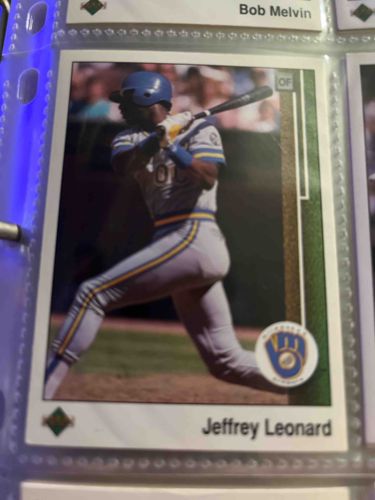
The item is a baseball trading card featuring player Jeffrey Leonard, depicted in a batting stance. The card appears to be standard trading card size, typically around 2.5 x 3.5 inches. It is constructed from cardboard with a glossy photographic print on the front. The primary colors visible are the gray and yellow uniform of the player, a blue helmet, and the green and brown background of a baseball field. The card has a white border around the central image.
Notable features include the player's name, "Jeffrey Leonard," printed in black text at the bottom. In the lower left corner, there is a small, green diamond-shaped logo, which is characteristic of Upper Deck baseball cards from the late 1980s to early 1990s. In the lower right corner, there is a circular logo featuring a stylized glove with an 'M' and 'B' incorporated, representing the Milwaukee Brewers. The upper right side of the card also has a small 'OF' (Outfielder) designation. The card's condition appears well-preserved within a plastic protector sheet, showing minimal visible wear or damage. There are no obvious creases, tears, or significant surface abrasions. The print quality seems sharp, indicating good manufacturing standards. The visible elements suggest this card belongs to a set from the period when Jeffrey Leonard played for the Milwaukee Brewers, likely early 1990s. The edges and corners appear intact, though a precise assessment for corner wear would require removal from the protective sleeve. The overall quality reflects typical mass-produced sports trading cards, with the Upper Deck brand often associated with higher-quality photography and card stock compared to some competitors of its era.
AI Appraisal Report
·AI can make mistakes·Verify before acting
I have carefully examined the provided image of the Jeffrey Leonard 1990-1991 Upper Deck Baseball Card. Based on my visual assessment, the card appears to be in excellent condition, showing minimal signs of wear. The edges and corners seem sharp, and there are no apparent creases, tears, or surface abrasions. The print quality is crisp, which is typical for Upper Deck cards of this era, known for their higher production standards. The presence of the green diamond-shaped Upper Deck logo and the Milwaukee Brewers team logo aligns with the card's stated origin.
Regarding market conditions, cards from the 1990s, often referred to as the 'junk wax' era, experienced massive overproduction. This abundance generally significantly depresses the value of most common player cards. While Jeffrey Leonard was a recognized player, he is not considered a Hall of Famer or a perennial All-Star whose cards would command high prices from this period. Demand for common player cards from this era is typically very low, and rarity is virtually non-existent due to the high print runs.
The primary factor impacting value here is the commonality of the card and the player within an overproduced set. Even in pristine condition, such a card holds limited monetary value. The protective sleeve is a positive, indicating care, but doesn't elevate the value substantially for a card of this type.
Limitations in authenticity verification from images alone are significant. While the card appears genuine based on visible branding and design elements, I cannot definitively verify its authenticity without physical inspection. An in-person examination would allow for precise assessment of card stock, surface texture, and microscopic print analysis to rule out counterfeits (though counterfeiting for common cards like this is rare). Provenance documentation, such as original packaging or purchase receipts, would further confirm its origin, though this is unlikely for a low-value card. Without physical inspection, I cannot assess subtle imperfections, such as very slight corner dings or surface dimples, that might not be visible in a photograph.