AI estimate as of July 17, 2025 · verify with a professional before acting
AI-Generated · Verify before acting
Everything on this page is generated by AI for informational purposes only. AI can make mistakes — the AI may misidentify items or misattribute them (artist, maker, brand, designer, origin, era). This is not an official valuation and should not be used for insurance, sale, tax, estate, legal, or lending purposes — or any decision requiring a certified appraisal. It is not an authoritative claim about any person, brand, or rights holder — do not share or rely on it as a factual statement about a third party. Always consult qualified professionals before making financial decisions.
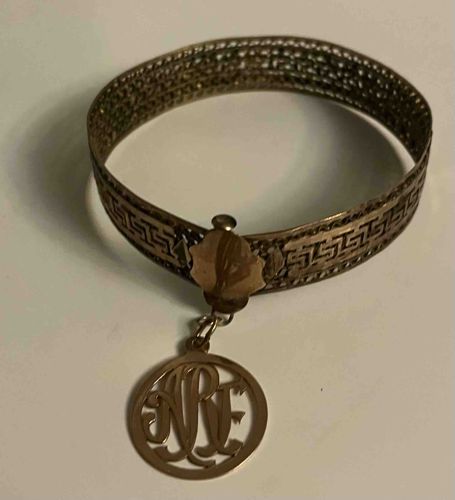
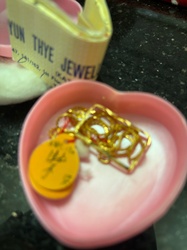
This item is a vintage filigree bangle bracelet, likely made of a base metal with a silver or silver-tone finish that has developed a dark patina, suggesting an older age and possible silver content or plating. The bracelet features an intricate filigree design across its entire width, forming geometric patterns and possibly floral motifs that are somewhat obscured by the aging of the metal. The edges of the bracelet are adorned with a repeating Greek key or meander pattern, indicating a classical influence in its design. Attached to the bracelet via a small clasp, which appears to be a hinged bail or a spring ring clasp, is a circular charm or pendant. This charm is flat and features intertwined block initials 'NRF' or 'NFF' cut out within an oval or circular frame. The craftsmanship of the filigree work appears delicate, indicating attention to detail. There are no visible maker's marks or signatures from the provided image. The overall condition shows significant tarnish and discoloration consistent with age and wear, but no obvious breaks or major structural damage are discernible. The clasp mechanism on the charm attachment also shows signs of oxidation. The style points to a period between the late 19th and early 20th centuries, possibly Edwardian or Art Deco era, given the filigree and geometric patterns. The personalized monogram adds a unique aspect to the piece, suggesting it was a custom or highly personal item.
AI Appraisal Report
I have examined the image of this vintage filigree bangle bracelet with a monogram charm. Based on the visual evidence, the bracelet appears to be a legitimate vintage piece, likely from the late 19th to early 20th century, possibly Edwardian or early Art Deco, given the intricate filigree and Greek key motifs. The dark patina and discoloration are consistent with age and indicate a base metal, possibly silver or silver-plated, that has tarnished over time. I observe no obvious structural damage, though the significant tarnish obscures certain details of the filigree and the clasp mechanism. The craftsmanship of the filigree work appears delicate, suggesting a quality piece for its era. The monogrammed charm adds a unique, personalized touch.
Authenticity verification from images alone is limited. While the style strongly suggests its vintage origin, a physical examination would be necessary to definitively confirm the metal composition (e.g., silver content, if any), assess the true condition of the metal and clasp mechanisms, and search for any hidden maker's marks. X-ray fluorescence (XRF) testing would confirm metal purity, and a jeweler's loupe would allow for a detailed inspection of the filigree and clasp integrity. Provenance documentation, if available, would further solidify its history and authenticity.
Market conditions for vintage costume jewelry or silver-tone pieces of this type vary. While the filigree work is appealing, the unknown metal content and the personalized monogram (unless it matches a buyer's initials) can limit broad appeal. Comparables would include similar vintage filigree bangles, with those in better condition or confirmed silver fetching higher prices. The demand for such a specific, monogrammed piece is niche, making it somewhat less liquid. However, the intricate workmanship and age still hold value for collectors of period jewelry.
Factors significantly impacting value are primarily the unknown metal content and the specific monogram. If found to be sterling silver, the value would increase. The current state of tarnish, while indicative of age, also reduces immediate visual appeal and would likely require professional cleaning, which is a common expectation for vintage jewelry purchases. Without physical inspection, the value range is cautiously estimated.