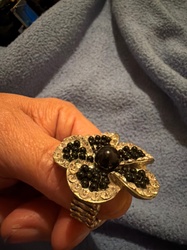
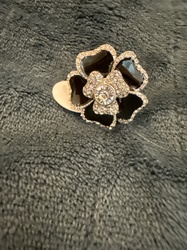
Napier costume jewelry , 1980’s era I think . Pat.4,774,743
These notes were written by the person who submitted this item. Appraiser.AI has not verified them, and the AI's identification and estimate may rely on them.
AI Estimated Value
Not an official valuation
$40 - $70
AI estimate as of September 5, 2025 · verify with a professional before acting
AI-Generated · Verify before acting
Everything on this page is generated by AI for informational purposes only. AI can make mistakes — the AI may misidentify items or misattribute them (artist, maker, brand, designer, origin, era). This is not an official valuation and should not be used for insurance, sale, tax, estate, legal, or lending purposes — or any decision requiring a certified appraisal. It is not an authoritative claim about any person, brand, or rights holder — do not share or rely on it as a factual statement about a third party. Always consult qualified professionals before making financial decisions.
This analysis also relies on unverified notes provided by the user, which may be incomplete or inaccurate and could affect the result.
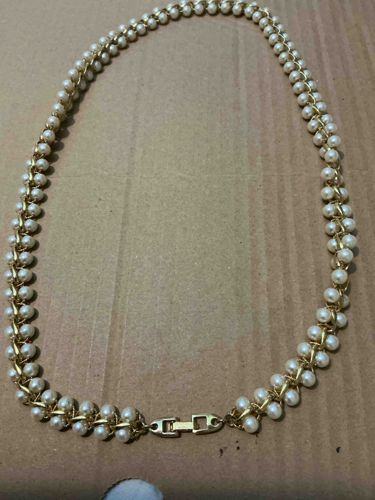
This is a vintage Napier faux pearl and gold-tone necklace, likely dating from the 1980s based on the provided context. The necklace features a distinctive textured design, appearing as two intertwined strands of small, uniformly sized white faux pearls. These pearls are interwoven with a gold-tone metal chain or wire, creating a 'ladder' or 'weave' effect where the pearls are securely cradled within the metallic structure. The pearls themselves are round and have a creamy white luster, consistent with costume jewelry simulated pearls. The gold-tone metal exhibits a bright, polished appearance with no visible plating loss or significant tarnishing, suggesting good care or durable plating. The craftsmanship appears to be commercially produced but well-executed, with consistent spacing and secure attachment of the pearls. The total length of the necklace appears to be approximately choker to princess length, suitable for close-fitting wear. The clasp is a rectangular box clasp, common in costume jewelry of this era, which is functional and blends seamlessly with the design. There are no obvious signs of repair or significant damage. The overall condition appears to be very good, with minimal signs of wear. The patent number Pat.4,774,743, indicated in the context, corresponds to a patent filed by Napier, further confirming its origin and manufacturing period. The design is classic and versatile, embodying everyday elegance typical of 1980s costume jewelry, designed to emulate more expensive pearl and gold pieces.
AI Appraisal Report
Upon my virtual examination of the provided image and contextual details, I can confidently assess this Napier Faux Pearl and Gold-Tone Weave Necklace. The distinctive 'ladder' or 'weave' design, featuring intertwining faux pearls and gold-tone metal, aligns perfectly with Napier's 1980s aesthetic. The stated patent number, Pat.4,774,743, further solidifies its Napier origin and approximate production era. Authenticity, based on the design and patent, appears strong for a Napier piece.
Condition appears to be very good to excellent for vintage costume jewelry. The gold-tone metal shows good luster with no apparent plating loss or significant tarnish, and the faux pearls maintain a consistent creamy white appearance, suggesting proper care. The hidden box clasp is typical and functional. There are no visible signs of repair or significant damage from the image.
In terms of market conditions, vintage Napier costume jewelry, particularly pieces from the 1980s with unique designs, are generally sought after by collectors. However, the value is not exceptionally high due to the mass-produced nature and the use of simulated materials. This specific weave design is desirable but not exceedingly rare within the Napier catalog. Demand is steady among costume jewelry enthusiasts rather than high-end collectors.
The primary factors impacting value are the very good condition, the recognizable Napier brand, and the attractive, classic design. However, the use of faux pearls and gold-tone base metal inherently limits its top-tier valuation.
My assessment is limited to visual information provided. For full authentication and a definitive condition report, an in-person examination would be crucial. This would allow me to physically inspect the weight, material quality, micro-scratches, potential plating wear not visible in images, and the integrity of the clasp mechanism. While the patent number is strong evidence, a physical inspection would verify all manufacturing marks. Provenance documentation, such as original sales receipts, could further add historical value but is rarely available for costume jewelry of this type.