AI estimate as of November 20, 2025 · verify with a professional before acting
AI-Generated · Verify before acting
Everything on this page is generated by AI for informational purposes only. AI can make mistakes — the AI may misidentify items or misattribute them (artist, maker, brand, designer, origin, era). This is not an official valuation and should not be used for insurance, sale, tax, estate, legal, or lending purposes — or any decision requiring a certified appraisal. It is not an authoritative claim about any person, brand, or rights holder — do not share or rely on it as a factual statement about a third party. Always consult qualified professionals before making financial decisions.
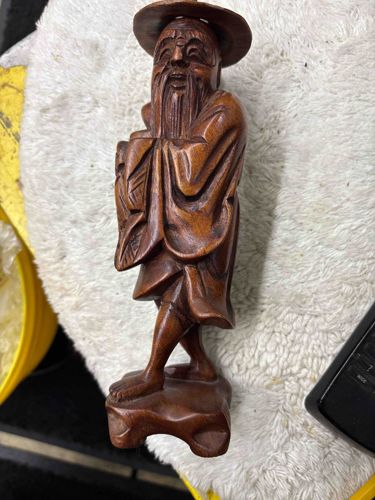
This is a carved wooden figure depicting an elderly, bearded man, possibly a sage, scholar, or deity, often associated with East Asian cultures. The figure is crafted from a dark brown wood, showcasing a rich, warm tone with visible wood grain, suggesting a natural finish or a light stain that highlights the material. The carving is executed with notable detail, particularly in the facial features, which include a prominent forehead, squinting or smiling eyes, and a long, flowing beard that extends down to his chest. He also sports a mustache and a small soul patch. The man wears a wide-brimmed, flat hat and robes with gracefully draped folds, indicating movement or a flowing fabric. His hands appear to be held together or are holding an unseen object near his chest, partially obscured by the sleeves of his robes. The figure stands on a roughly carved, irregular base, designed to mimic natural rock or an unhewn piece of wood, providing stability to the sculpture. The carving style exhibits a folk art aesthetic combined with traditional East Asian artistic conventions. There are no immediate visible signs of major damage such as cracks or chips, though minor surface wear and a natural patina consistent with age and handling are likely present, contributing to its aged character. The craftsmanship appears to be a good quality hand-carving, evident in the intricate details of the beard and drapery, suggesting a skilled artisan. The figure's posture and expression convey a sense of wisdom and serenity. Its style suggests it could be from the early to mid-20th century, but without more specific markings, it's difficult to pinpoint an exact age. This type of figure is often used for decorative purposes, reflecting cultural archetypes.
AI Appraisal Report
Based on my visual examination of the provided image, this carved wooden figure of an elderly, bearded man exhibits good craftsmanship, particularly in the detailed facial features and the flowing drapery of the robes. The dark wood and visible grain suggest a natural material, possibly with a light stain, contributing to its warm aesthetic. The overall condition appears good from the image; I don't observe any significant cracks or chips, though I would expect minor surface wear and a natural patina consistent with age and handling if I were to inspect it in person. The folk art style combined with traditional East Asian conventions is appealing.
From a market perspective, decorative wooden figures of this type, often depicting sages or deities, are relatively common. While this piece is well-executed, the absence of specific artist signatures, unique identifying marks, or a distinguished provenance limits its potential for higher value. Comparable items, typically from the early to mid-20th century as this appears to be, often sell in the low to mid-hundreds depending on condition, size, and carved detail. There's a steady, though not exceptionally high, demand for such culturally resonant decorative pieces. Rarity is not a significant factor here; while unique in its specific carving, the genre is broadly available.
Limitations in authenticity verification from an image alone are considerable. I cannot confirm the exact type of wood used, nor can I definitively ascertain the carving method (fully hand-carved vs. partially machine-assisted, then finished by hand) without physical inspection. An in-person examination would allow for a tactile assessment of the surface, detection of fills or repairs, and a more precise evaluation of wear patterns. Additionally, examination under UV light could reveal repairs or overpainting. For full authentication and to potentially command a higher value, documentation of provenance—such as where and when it was acquired, and any history of ownership—would be crucial. Without such, the appraisal reflects a decorative art piece of decent quality but lacking the verifiable history or unique attributes that would elevate it into a higher value bracket.