AI estimate as of October 29, 2025 · verify with a professional before acting
AI-Generated · Verify before acting
Everything on this page is generated by AI for informational purposes only. AI can make mistakes — the AI may misidentify items or misattribute them (artist, maker, brand, designer, origin, era). This is not an official valuation and should not be used for insurance, sale, tax, estate, legal, or lending purposes — or any decision requiring a certified appraisal. It is not an authoritative claim about any person, brand, or rights holder — do not share or rely on it as a factual statement about a third party. Always consult qualified professionals before making financial decisions.
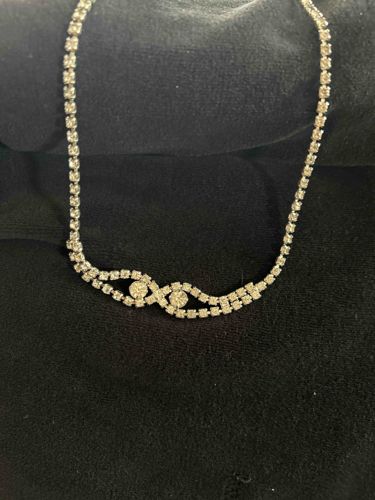
This item is a rhinestone choker necklace, likely designed for formal or costume wear. It features a silver-tone metal construction, possibly a base metal like pot metal or brass plated with rhodium or silver, judging by its bright, untarnished appearance. The necklace is composed primarily of small, square-cut rhinestones forming two parallel chains. These chains converge at the center front into an ornate, stylized motif, where two larger, round-cut rhinestones are prominently featured. These larger stones are set within what appears to be a figure-eight or infinity-like design, itself outlined and filled with smaller square rhinestones. The overall construction suggests a pave setting for the smaller stones, ensuring maximum sparkle. The necklace does not show significant signs of wear, tarnish, or missing stones, indicating either careful storage, minimal use, or relatively recent manufacture. Without a visible clasp or full length, it is presumed to be a choker style due to its apparent length and design intended to sit high on the neck. There are no visible maker's marks or stamps in the provided images. The style is classic and timeless for costume jewelry, popular from the mid-20th century onwards as an accessible alternative to diamond jewelry. Its quality, while typical for mass-produced costume pieces, appears to be good given the evenness of the stone settings and lack of visible flaws.
AI Appraisal Report
Based on my visual examination of the provided image, this rhinestone choker necklace appears to be in very good condition. There is no discernible tarnish, missing stones, or significant wear, suggesting either careful handling, minimal use, or relatively recent manufacture. The setting of the stones appears consistent and well-executed for costume jewelry. Authenticity, in this context, refers to it being what it purports to be – a period or vintage costume piece, which it seems to be. The design is a classic, accessible style popular in costume jewelry from the mid-20th century onwards.
Market conditions for costume jewelry of this type are generally stable. While not 'rare,' well-preserved rhinestone chokers with attractive designs like this one maintain a steady demand, especially within the vintage and costume jewelry collecting communities, or for those seeking period-appropriate accessories. Comparables for similar vintage rhinestone chokers in good condition typically range from $30 to $100, depending on the intricacy of the design, overall condition, and perceived quality of stones and metalwork.
Factors significantly impacting value here are primarily its excellent condition and timeless design. The absence of a visible maker's mark prevents attribution to a specific, potentially more collectible designer, which would otherwise elevate its value.
It is crucial to note the limitations of image-based appraisal. Without physical inspection, I cannot definitively assess the true material composition of the metal (e.g., confirm if it's pot metal, brass, or rhodium/silver plated, or even actual silver in a rare case for costume) or the quality of the rhinestones beyond their visual sparkle. An in-person examination would allow me to check for actual structural integrity, the method of stone setting, the quality of the clasp (if present), and any tactile cues of age or material. Additionally, provenance documentation would be beneficial if it claimed to be from a specific designer or era, but for general costume, this is seldom available or expected.