These notes were written by the person who submitted this item. Appraiser.AI has not verified them, and the AI's identification and estimate may rely on them.
AI Estimated Value
Not an official valuation
$500 - $1,500
AI estimate as of September 2, 2025 · verify with a professional before acting
AI-Generated · Verify before acting
Everything on this page is generated by AI for informational purposes only. AI can make mistakes — the AI may misidentify items or misattribute them (artist, maker, brand, designer, origin, era). This is not an official valuation and should not be used for insurance, sale, tax, estate, legal, or lending purposes — or any decision requiring a certified appraisal. It is not an authoritative claim about any person, brand, or rights holder — do not share or rely on it as a factual statement about a third party. Always consult qualified professionals before making financial decisions.
This analysis also relies on unverified notes provided by the user, which may be incomplete or inaccurate and could affect the result.
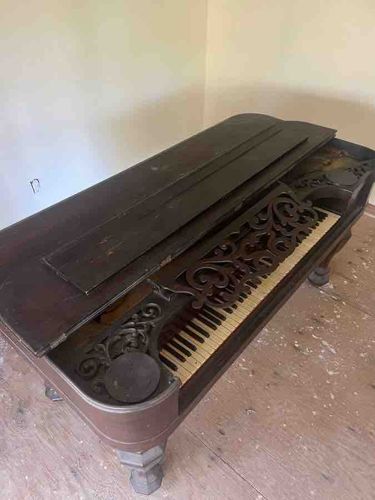
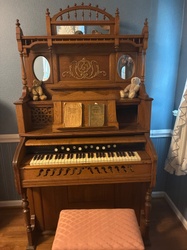
This appears to be an antique square grand piano, characterized by its long, rectangular cabinet and horizontal strings. The instrument is constructed primarily from dark wood, likely mahogany or rosewood, given the deep reddish-brown tones visible, especially on the side panels and legs. The finish appears to be very worn and dulled, suggesting significant age and lack of recent maintenance, with areas of discoloration and potential loss of original varnish or polish. The keyboard features a full set of keys, with the white keys showing substantial yellowing and discoloration, indicating aging of the ivory or celluloid key covers, and some black keys are present. A prominent feature is the elaborately carved or cast iron musical rest, showcasing intricate scrollwork and floral motifs, which speaks to late 19th-century aesthetics, possibly Rococo Revival or Victorian styles. Two circular, dark, possibly brass or iron components are visible at each end of the keyboard, which might have served as candle holders or decorative finials. The instrument rests on four sturdy, turned wooden legs, octagonal or similarly multifaceted in form, exhibiting a similar dark wood and a heavily worn finish. The top lid of the piano is in two parts; one is partially open, revealing a glimpse into the soundboard area, while the other portion is closed. The overall condition suggests a state of disrepair, with visible dust and debris, and likely requiring extensive restoration to be playable or aesthetically pristine. The mention of 'Oarsman Gray & Co' in the context could indicate the original manufacturer or a past owner/restorer, which would be a significant identifying mark if found on the instrument itself. The design suggests it dates from the mid-to-late 19th century.
AI Appraisal Report
Upon examining the provided image and details, this antique square grand piano, identified as possibly from 'Oarsman Gray & Co.', presents a fascinating case. Its construction from dark wood, likely mahogany or rosewood, suggests quality materials, and the elaborate musical rest points to a mid-to-late 19th-century aesthetic. The presence of 'Oarsman Gray & Co.', if verifiable on the instrument itself, is a critical identifier that could greatly aid in dating and potentially authenticating its origins.
However, the piano's condition is a significant detractor from its immediate value. The heavily worn and dulled finish, discolored and yellowed keys, and visible dust and debris indicate a state of substantial disrepair. This severely impacts its aesthetic and functional appeal, rendering it unplayable in its current state without extensive and costly restoration. The market for square grand pianos is niche; while they are historically significant and rarer than uprights or modern grands, their large size and often unplayable condition limit demand among collectors who prioritize playable instruments or those in pristine condition.
Comparables for unrestored square grand pianos typically fall into a wide range, from a few hundred dollars for those primarily valued for parts or as decorative 'props', to several thousand for rare examples in remarkably good original condition or fully restored. Given this piano's current state, its value is largely decorative or as a restoration project.
Authenticity verification from images alone is limited. While the style aligns with the described period, a definitive assessment of authenticity and the 'Oarsman Gray & Co.' claim requires an in-person examination to locate and verify any maker's marks, serial numbers, and assess the internal mechanisms. Provenance documentation, if available, would further substantiate its history. Without physical inspection, including opening the case to inspect the soundboard and pin block, the extent of structural damage and restoration costs cannot be accurately assessed. My appraisal range reflects its 'as is' condition, anticipating significant restoration required to bring it to a playable or display-quality state.