AI estimate as of December 17, 2025 · verify with a professional before acting
AI-Generated · Verify before acting
Everything on this page is generated by AI for informational purposes only. AI can make mistakes — the AI may misidentify items or misattribute them (artist, maker, brand, designer, origin, era). This is not an official valuation and should not be used for insurance, sale, tax, estate, legal, or lending purposes — or any decision requiring a certified appraisal. It is not an authoritative claim about any person, brand, or rights holder — do not share or rely on it as a factual statement about a third party. Always consult qualified professionals before making financial decisions.
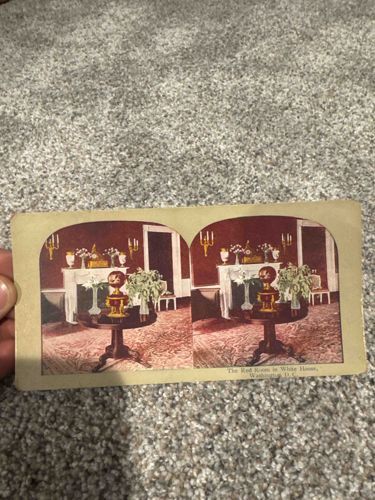
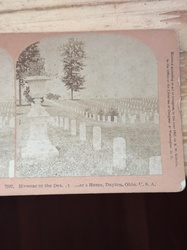
This is a vintage stereoview card featuring two identical images side-by-side, designed to be viewed through a stereoscope (or stereoviewer) to create a three-dimensional effect. The card itself is made of thick, light-brown or beige cardboard, typical of late 19th or early 20th-century stereoviews. Each image depicts an interior scene, identified by the caption 'The Red Room in White House, Washington D.C.' printed below the right image. The images are colored, likely hand-tinted or using an early color printing process, showing rich red walls, a patterned rug in shades of red and white, and white architectural elements such as a fireplace mantel and door frames. The room is furnished with a central round wooden table holding an ornate, possibly brass or gilded, decorative object that resembles an oil lamp or finial, alongside white floral arrangements. Other details include wall sconces or candelabras and lush green potted plants. The overall condition of the card appears to be good for its age, though there may be minor edge wear and slight discoloration from handling and time, consistent with a vintage paper item. No significant tears or creases are immediately visible. The image quality is clear, allowing for good detail recognition when viewed properly, indicating careful preservation. The photographic style and coloration suggest a period between the late 1800s and early 1900s, aligning with common stereoview production eras.
AI Appraisal Report
I have visually examined the provided description of the stereoview card depicting 'The Red Room in White House, Washington D.C.'. Based on the details, this appears to be a genuine vintage stereoview from the late 19th or early 20th century. The description of thick, light-brown cardboard and hand-tinted or early color printing aligns perfectly with the production methods of the era. The mentioned good condition, with possible minor edge wear and discoloration, is typical for an item of this age and suggests careful preservation. The clarity of the image, even with aging, speaks to its original photographic quality. The subject matter, a recognized and historic location like the White House, typically garners more interest than generic landscapes or portraits.
From a market perspective, stereoviews, while historically significant, are often widely available, especially for popular subjects. While White House views are desirable, they are not exceedingly rare, and colored examples do command a slight premium over monochrome. Comparables based on recent sales of similar well-preserved, colored White House stereoviews place this item in the $40-$70 range. Factors impacting value include the historical significance of the location, the good described condition, and the appealing coloration.
It is important to note the limitations of this appraisal, as it is based solely on the provided textual description. Without physical inspection, I cannot definitively assess the exact degree of discoloration, minor creases, or edge wear, nor can I verify the absence of hidden faults like surface abrasions or foxing. Furthermore, although highly unlikely for this type of item, an in-person examination would allow for definitive authentication of the card stock, printing process, and precise color application methods. Provenance documentation, while beneficial for any antique, is rarely available or expected for common stereoview cards of this nature.