AI estimate as of July 13, 2025 · verify with a professional before acting
AI-Generated · Verify before acting
Everything on this page is generated by AI for informational purposes only. AI can make mistakes — the AI may misidentify items or misattribute them (artist, maker, brand, designer, origin, era). This is not an official valuation and should not be used for insurance, sale, tax, estate, legal, or lending purposes — or any decision requiring a certified appraisal. It is not an authoritative claim about any person, brand, or rights holder — do not share or rely on it as a factual statement about a third party. Always consult qualified professionals before making financial decisions.
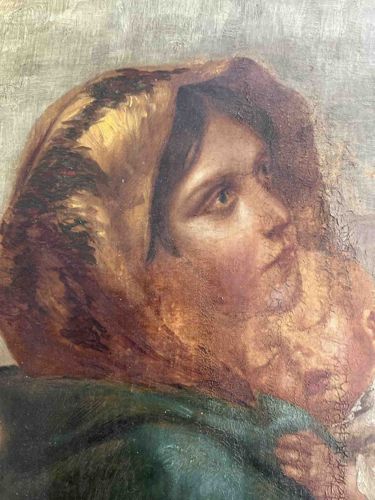
This is a close-up detail of an oil painting, likely executed on canvas, depicting a female figure. The visible portion shows the head and upper torso of a young woman or maiden, characterized by a fair complexion, dark hair, and expressive eyes gazing upwards and to the right. She is adorned with a brown or reddish-brown head covering or scarf, possibly linen or wool, which drapes over her head and shoulders, showing folds and highlights indicating the texture of the fabric. Beneath the head covering, a dark, possibly green or dark blue garment is visible, suggesting a mantle or cloak, rendered with visible brushstrokes that indicate textile. The painting exhibits signs of age and wear, including significant craquelure, particularly in the lower right and across the lighter skin tones, indicating the drying and shrinking of paint layers over time. There are also areas of paint loss, especially noticeable on the right side of the face and within the head covering, revealing what appears to be the underlying ground layer or even the canvas itself. The brushwork appears deliberate, showcasing a classical or academic style, possibly from the 19th or early 20th century, given the apparent age and painting technique. The overall impression suggests a portrait or a figure study, possibly religious or allegorical in nature, though the limited view prevents full identification of the subject or larger narrative. No discernible maker's marks or signatures are visible in this cropped view.
AI Appraisal Report
I have carefully examined the provided image of a Fragment of an Oil Painting Depicting a Female Figure in a Head Covering. Visually, the painting exhibits significant craquelure and areas of paint loss, particularly on the right side of the face and within the head covering, revealing what appears to be ground or canvas. This indicates considerable age and wear, consistent with a work from the 19th or early 20th century. The brushwork suggests a classical or academic style, possibly a portrait or figure study.
Authenticity is a major concern given the limited visual information. Without physical examination, I cannot attest to the authenticity of the artwork's age, medium, or artist. The lack of discernible signatures or maker's marks is also a limiting factor for attribution. To confirm authenticity and better assess condition, an in-person examination by a conservator or art historian is crucial. This would allow for detailed analysis of paint layers, pigments, ground, and canvas, as well as the nature of the craquelure and paint loss. Provenance documentation, such as exhibition history, sales records, or family ownership, would also be essential for establishing the painting's history and potential attribution.
Regarding market conditions, fragments of paintings generally face lower demand than complete works, unless they are attributed to highly significant artists. Comparables for damaged, unsigned oil fragments from this period are limited and typically command lower prices. The potential rarity depends entirely on attribution; currently, it is an unidentified work. Without attribution to a known artist, the value is primarily decorative, reflecting its aesthetic appeal despite damage. Factors significantly impacting value are the current condition issues and, most importantly, the unknown artist and lack of provenance. Should further research or physical examination reveal a significant artist, the value would increase dramatically. However, without such substantiation, its market appeal is significantly curtailed. The absence of a clear subject or narrative also limits its broader appeal.