These notes were written by the person who submitted this item. Appraiser.AI has not verified them, and the AI's identification and estimate may rely on them.
AI Estimated Value
Not an official valuation
$40-$65
AI estimate as of August 7, 2025 · verify with a professional before acting
AI-Generated · Verify before acting
Everything on this page is generated by AI for informational purposes only. AI can make mistakes — the AI may misidentify items or misattribute them (artist, maker, brand, designer, origin, era). This is not an official valuation and should not be used for insurance, sale, tax, estate, legal, or lending purposes — or any decision requiring a certified appraisal. It is not an authoritative claim about any person, brand, or rights holder — do not share or rely on it as a factual statement about a third party. Always consult qualified professionals before making financial decisions.
This analysis also relies on unverified notes provided by the user, which may be incomplete or inaccurate and could affect the result.
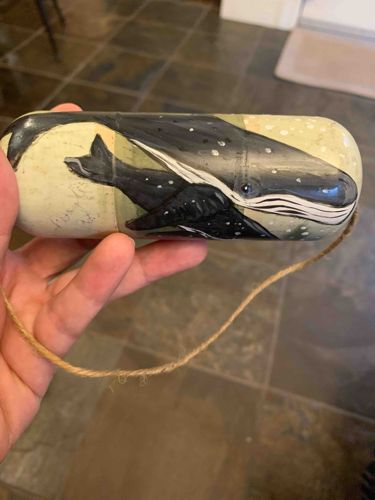
This item is a hand-painted wooden object, cylindrical in shape with rounded ends, resembling a stylized buoy, rolling pin, or a large, elongated bead. It is primarily painted with a marine-themed motif, specifically a large whale, likely a humpback or blue whale, depicted in dark grey and black tones with white accents for its baleen plates and speckled white markings suggesting water spray or barnacles. The background of the painting transitions from a light, almost yellowish-white on the left to a pale green or muted olive tone on the right, with faint white dots implying light or distant stars. The overall aesthetic suggests a folk art or nautical theme.
The object itself appears to be made from a single piece of carved wood, providing a smooth, uniform surface for the painting. The paint strokes are visible, indicating a hand-painted application rather than a mass-produced print. The artist's signature, "P Doyle NL," is visible on the left side of the object, partially obscured by the hand holding it. "NL" likely refers to Newfoundland, given the reference in the context.
The condition appears good, with no overt signs of damage such as chips, cracks, or significant paint loss. There might be some minor scuffs, but the overall integrity of the painted surface seems well-preserved. A natural twine or jute string is attached to one end, suggesting it is intended for hanging as an ornament or decorative piece. The craftsmanship, while not hyper-realistic, indicates a skilled hand in capturing the essence of the whale. The rounded edges and smooth finish suggest a certain level of care in its creation. This piece likely dates from the late 20th to early 21st century, consistent with contemporary folk art and souvenir items from maritime regions.
AI Appraisal Report
Upon visual examination of the Hand-Painted Wooden Whale Buoy Ornament, I assess it to be a charming piece of contemporary Canadian folk art. The item is signed 'P Doyle NL', which plausibly attributes it to an artist from Newfoundland and Labrador, a region known for its rich tradition of maritime-themed crafts. The painting, depicting a whale, is executed with skill and character, consistent with artisan-made decorative objects. The condition appears very good, with the paint well-preserved and no obvious signs of chips or cracks visible in the provided image. The use of natural twine for hanging is appropriate for its style.
From a market perspective, comparable hand-painted folk art ornaments from Newfoundland and other maritime regions typically sell in a modest price range. The value is driven by the quality of the artistry, the artist's local reputation, and collector demand for nautical-themed decor. While 'P Doyle' may be a known local artist, without further provenance, the piece is appraised as a high-quality decorative craft item rather than fine art. Its primary value lies in its aesthetic appeal and craftsmanship.
It is important to note the limitations of an appraisal based solely on images. Full authentication would require physical inspection to confirm the type of wood, the age of the paint, and the authenticity of the signature. Verifying the artist's identity and exhibition history through provenance documentation would be necessary to potentially elevate its value. Without this, my valuation is based on its merits as a well-made, signed piece of regional folk art.