AI estimate as of October 19, 2025 · verify with a professional before acting
AI-Generated · Verify before acting
Everything on this page is generated by AI for informational purposes only. AI can make mistakes — the AI may misidentify items or misattribute them (artist, maker, brand, designer, origin, era). This is not an official valuation and should not be used for insurance, sale, tax, estate, legal, or lending purposes — or any decision requiring a certified appraisal. It is not an authoritative claim about any person, brand, or rights holder — do not share or rely on it as a factual statement about a third party. Always consult qualified professionals before making financial decisions.
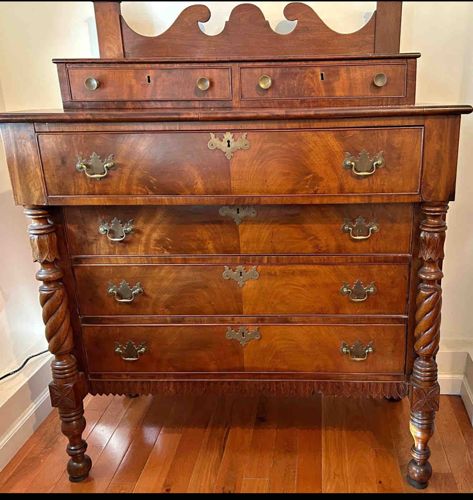
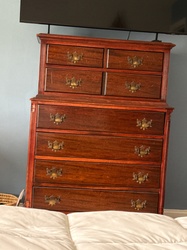
This is a substantial antique chest of drawers, likely dating from the Empire or Late Federal period (early to mid-19th century), constructed primarily from a rich, reddish-brown wood, possibly mahogany or a similar fruitwood, exhibiting prominent swirled grain patterns (flame or crotch veneer) on the drawer fronts. The chest features a rectangular top and stands on four turned legs that extend from heavily carved, spiraled columnar supports on the front. These supports terminate in squared blocks near the base, which are also carved with what appears to be a floral or foliate motif. Below the main body of the chest, there is a decorative, carved apron with a scalloped or fringed edge, adding to its ornate character. The chest comprises four large, graduated drawers, increasing in depth from top to bottom, each fitted with two ornate brass bail pulls and a central brass escutcheon, indicating a locking mechanism or purely decorative feature. The brass hardware shows a natural patina consistent with age. Above the main chest, a smaller, freestanding bureau-style unit is affixed, featuring two smaller drawers with brass knob pulls and a central keyhole. This upper unit is topped with a carved backsplash, characterized by a scrolling, undulating silhouette. The overall condition appears to be good for its age, with an aged patina, some minor surface wear, and possibly some small scratches or dents consistent with historical use, but no major visible damage or repairs are immediately apparent. The craftsmanship indicates a carefully constructed piece of furniture, typical of the periods known for detailed carving and veneer work.
AI Appraisal Report
Based on my visual examination of the provided image, this Empire or Late Federal Style Chest of Drawers with Mirror appears to be an authentic piece from the early to mid-19th century. The construction, featuring prominent flame mahogany veneer, spiraled columnar supports, carved apron, andperiod-appropriate brass hardware (bail pulls and escutcheons), is consistent with furniture made during this era. The condition appears to be good for its age, exhibiting an attractive aged patina, which is desirable and suggests original finish. I observe no obvious signs of significant damage, extensive repairs, or missing components from the image. The integration of the smaller bureau-style unit and scrolling backsplash further reinforces its period charm and utility.
In terms of market conditions, well-preserved examples of Empire and Late Federal furniture, particularly those with strong decorative elements and desirable woods like mahogany, continue to find a market among collectors and those furnishing period homes. Comparables for chests of this size and stylistic quality, especially those retaining original hardware and finish, typically range from $1,500 to $3,000, depending on provenance and specific craftsmanship. This piece's ornate carving and high-quality veneer work contribute positively to its demand and perceived rarity among general antique offerings. Factors significantly impacting its value include its good apparent condition, original design, and period authenticity.
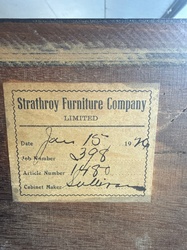
It is important to note the limitations of image-based appraisal. While the visual indicators are strong, a full authentication would require in-person examination to assess the internal construction (type of joinery, secondary woods), the originality of all components (especially the veneer and hardware), and to verify the finish and lack of significant repairs or alterations. Provenance documentation, if available, would also greatly enhance the certainty of its origin and potentially its value. Without physical inspection, I cannot entirely rule out skillful reproductions or later modifications.