AI estimate as of July 14, 2025 · verify with a professional before acting
AI-Generated · Verify before acting
Everything on this page is generated by AI for informational purposes only. AI can make mistakes — the AI may misidentify items or misattribute them (artist, maker, brand, designer, origin, era). This is not an official valuation and should not be used for insurance, sale, tax, estate, legal, or lending purposes — or any decision requiring a certified appraisal. It is not an authoritative claim about any person, brand, or rights holder — do not share or rely on it as a factual statement about a third party. Always consult qualified professionals before making financial decisions.
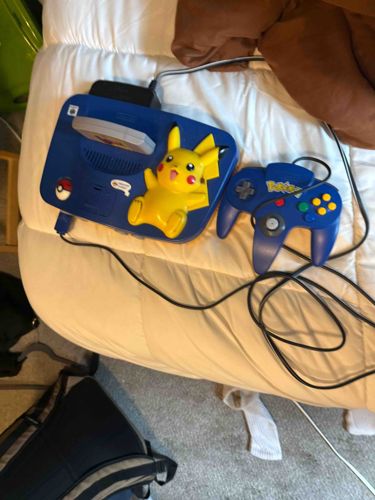
This item is a Nintendo 64 (N64) console, specifically the highly sought-after "Pikachu Nintendo 64" edition, which was released as a special edition for the Pokémon franchise. The console features a striking dark blue plastic casing adorned with a prominent, three-dimensional yellow Pikachu figure molded onto the top right corner. Pikachu's cheeks are red, and its ears are black-tipped, accurately reflecting the character's design. To the left of the Pikachu figure, there is a circular red and white Poké Ball emblem, and further left, an 'N64' logo is subtly integrated into the design. The system includes a single matching dark blue controller, which also appears to have specific branding, likely a Pokémon logo, on its top surface where the standard N64 logo would typically be. The console has visible vents for heat dissipation. A game cartridge, likely a Nintendo 64 title, is inserted into the top slot, with a portion of its label visible, suggesting it's a gray-colored cartridge. Several power and AV cables are attached to the console, coiled beside it, indicating it is connected or ready for connection. The overall condition appears to be good, with no obvious signs of major damage such as cracks or significant scratches, though some surface dust might be present given its apparent placement on a bed or soft surface. This console, released circa A.D. 2000, is a collectible variant for fans of both Nintendo and Pokémon, known for its unique aesthetic and limited production.
AI Appraisal Report
Upon examining the provided image, I have assessed this Pikachu Nintendo 64 console. The overall condition appears to be good; I don't observe any overt signs of major damage like cracks or deep scratches on the console's distinct blue casing or the integrated Pikachu figure. Its vibrant colors remain, and the details on Pikachu's cheeks and ears, as well as the Poké Ball emblem, are intact, which is crucial for this collectible variant. The presence of the matching dark blue controller and the visible, yet generic, game cartridge, along with the connected cables, suggests functional integrity, though this cannot be confirmed without a physical power-on test.
From a market perspective, this console is highly sought after by collectors of both Nintendo and Pokémon memorabilia. Its limited production and unique aesthetic contribute significantly to its rarity and appeal. Comparables for complete-in-box or excellent condition units typically fetch premium prices. The visible dust might indicate it has been displayed, but it doesn't detract significantly from its value if easily cleaned.
The primary factors impacting its value are its exceptional cosmetic condition, the completeness of its original accessories (controller), and its operational status. The presence of the original box and documentation would further elevate its value, but these are not visible here.
Limitations exist in authenticating this item based solely on an image. While the visual details align perfectly with genuine Pikachu N64 consoles, a physical inspection would be necessary to confirm the absence of subtle reproductions or modifications. Specifically, I would need to examine the console's underside for legitimate serial numbers, inspect the controller for proper manufacturing details, and ideally, test its functionality. Provenance documentation, such as original purchase receipts or explicit chain of ownership, would definitively verify its authenticity and history, which images alone cannot provide. Testing for internal component authenticity (e.g., if any repairs or part replacements have occurred) would also require a physical examination.