These notes were written by the person who submitted this item. Appraiser.AI has not verified them, and the AI's identification and estimate may rely on them.
AI Estimated Value
Not an official valuation
$600-800
AI estimate as of November 12, 2025 · verify with a professional before acting
AI-Generated · Verify before acting
Everything on this page is generated by AI for informational purposes only. AI can make mistakes — the AI may misidentify items or misattribute them (artist, maker, brand, designer, origin, era). This is not an official valuation and should not be used for insurance, sale, tax, estate, legal, or lending purposes — or any decision requiring a certified appraisal. It is not an authoritative claim about any person, brand, or rights holder — do not share or rely on it as a factual statement about a third party. Always consult qualified professionals before making financial decisions.
This analysis also relies on unverified notes provided by the user, which may be incomplete or inaccurate and could affect the result.
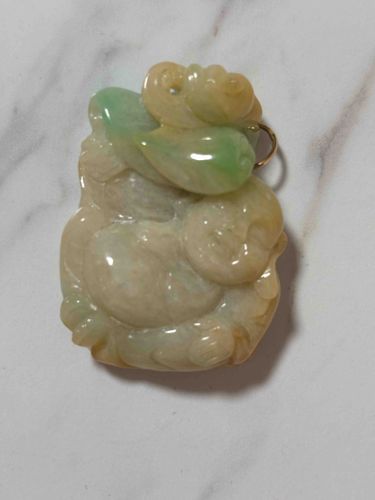
This is a vintage carved jadeite pendant, likely intended for a necklace, showcasing naturalistic and symbolic motifs. The pendant is composed of a single piece of jadeite, exhibiting a captivating blend of colors, primarily a creamy, translucent beige or off-white with significant inclusions and veins of vibrant apple-green. There are also subtle hints of a warmer, almost honey-yellow hue, particularly in recessed areas or along certain contours. The carving depicts what appears to be a stylized grouping of fruit, possibly gourds or peaches, intertwined with foliage, a common motif in East Asian art representing prosperity, longevity, and fertility. The carving is detailed, with smooth, polished surfaces and soft, rounded edges, indicative of skilled craftsmanship. The material has a waxy to vitreous luster characteristic of quality jadeite. The condition appears to be very good, with no visible chips, cracks, or significant abrasions. There is a small, simple gold-toned metal bail attached at the top of the pendant, suggesting it was designed to be worn as jewelry. The bail appears to be securely fixed. The overall aesthetic suggests an origin from the mid-20th century or earlier, consistent with the 'vintage' context provided, and the particular color distribution and translucency are often sought after in jadeite. The craftsmanship, material quality, and design collectively point to a piece intended for personal adornment with cultural significance.
AI Appraisal Report
Upon visual examination of the provided image, I assess this vintage carved jadeite pendant to be in very good condition. The carving, depicting stylized fruit and foliage, is detailed and shows no significant chips, cracks, or abrasions. The jadeite exhibits appealing coloration with creamy, off-white areas and vibrant apple-green inclusions, along with subtle hints of honey-yellow. The luster appears consistent with quality jadeite. The small gold-toned bail is securely attached.
Authenticity of jadeite, especially with specific origin and age, cannot be fully verified from images alone. An in-person examination would allow for precise testing of specific gravity, refractive index, and spectroscopic analysis to confirm it is natural, untreated Type A jadeite and not a simulant or treated stone (like Type B or C jadeite). Verification of the metal content of the bail would also require physical testing.
Considering current market conditions for oriental decorative arts and vintage jewelry, natural jadeite pieces with good carving and attractive coloration like this generally maintain steady demand. Comparable jadeite pendants of similar size, age, and quality typically fetch values within the range of $600 to $800 at auction or specialty vintage retailers. Rarity is moderate; while carved jadeite pendants are not exceedingly rare, attractive pieces in good condition with desirable color distribution are sought after. Factors positively impacting value include the naturalistic carving, the desirable blend of jadeite colors, and good condition. The primary limitation to a higher valuation is the inability to conduct definitive, in-person authenticity and treatment testing.