These notes were written by the person who submitted this item. Appraiser.AI has not verified them, and the AI's identification and estimate may rely on them.
AI Estimated Value
Not an official valuation
$45 - $75
AI estimate as of July 20, 2025 · verify with a professional before acting
AI-Generated · Verify before acting
Everything on this page is generated by AI for informational purposes only. AI can make mistakes — the AI may misidentify items or misattribute them (artist, maker, brand, designer, origin, era). This is not an official valuation and should not be used for insurance, sale, tax, estate, legal, or lending purposes — or any decision requiring a certified appraisal. It is not an authoritative claim about any person, brand, or rights holder — do not share or rely on it as a factual statement about a third party. Always consult qualified professionals before making financial decisions.
This analysis also relies on unverified notes provided by the user, which may be incomplete or inaccurate and could affect the result.
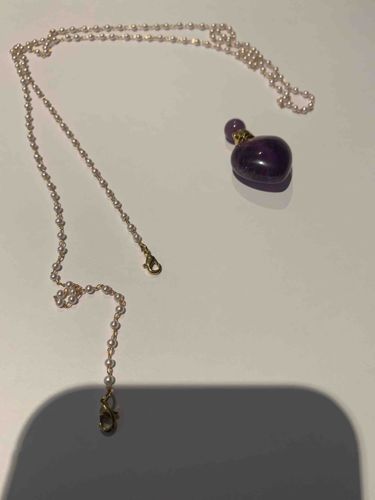
The item is a heart-shaped perfume bottle pendant crafted from what appears to be a polished purple stone, likely amethyst given its characteristic deep violet hue and natural striations visible within the stone. The pendant measures approximately 1.5 to 2 inches in height, including the stopper, and roughly 1 to 1.5 inches in width. The body of the bottle is smooth and heart-shaped, exhibiting a glossy finish. A small, round stoppable element, made of the same purple stone, is visible at the top, secured by what appears to be a brass or gold-toned metal collar and bail. This metal component shows a warm, slightly dulled yellow tone, suggesting it might be brass, gold-plated, or a lower karat gold. There are no visible maker's marks or signatures on the metalwork or the stone. The stone itself shows natural inclusions and variations in color intensity typical of natural mineral formations, adding to its uniqueness. The overall condition appears good, with no obvious chips, cracks, or severe abrasions visible on the stone. The metal components show some slight surface wear consistent with age and handling but no significant damage. The craftsmanship of the stone carving is smooth and well-formed, indicative of a competent lapidary artist. The item is accompanied by a fine, beaded chain, likely intended to be worn as a necklace, though it is not directly attached to the pendant in the image. This chain features uniformly sized, small, lustrous beads, possibly faux pearls or very small cultured pearls, connected by thin strands of what appears to be gold-toned wire or chain links. The chain includes two lobster claw clasps, suggesting it might be adaptable or designed for multiple wear styles, or perhaps includes an extender. Based on the material and style, this piece likely dates from the late 20th century to early 21st century.
AI Appraisal Report
Upon visual examination of the Amethyst Heart-Shaped Perfume Bottle Pendant with Beaded Chain, the piece presents in good condition. The heart-shaped bottle, carved from what is presumed to be natural amethyst, exhibits characteristic coloration and inclusions, with no visible chips or cracks. The stone carving is competent but not exceptionally fine. The metalwork, appearing to be brass or a base metal with gold plating, shows minor surface wear consistent with age and use. The accompanying beaded chain, likely composed of faux or small cultured pearls and gold-toned wire, appears to be a complementary but possibly not original pairing.
Market analysis for similar, unbranded amethyst perfume bottle pendants from the late 20th century places them in a modest price category. Demand for such items is steady among collectors of perfume bottles and unique jewelry, but they are not considered rare. The value is primarily derived from the decorative appeal and the material of the stone itself. The lack of a discernible maker's mark or precious metal content (like solid gold or sterling silver) significantly limits the item's value.
Without a physical inspection, I cannot definitively confirm the material composition. Full authentication would require testing the stone to confirm it is natural amethyst versus synthetic or glass, and testing the metal to determine its karat or composition. Provenance or a maker's mark would substantially alter the valuation. My appraisal is based on the assumption that the stone is amethyst and the metal is gold-plated brass.