These notes were written by the person who submitted this item. Appraiser.AI has not verified them, and the AI's identification and estimate may rely on them.
AI Estimated Value
Not an official valuation
$1,500 - $3,500
AI estimate as of July 1, 2025 · verify with a professional before acting
AI-Generated · Verify before acting
Everything on this page is generated by AI for informational purposes only. AI can make mistakes — the AI may misidentify items or misattribute them (artist, maker, brand, designer, origin, era). This is not an official valuation and should not be used for insurance, sale, tax, estate, legal, or lending purposes — or any decision requiring a certified appraisal. It is not an authoritative claim about any person, brand, or rights holder — do not share or rely on it as a factual statement about a third party. Always consult qualified professionals before making financial decisions.
This analysis also relies on unverified notes provided by the user, which may be incomplete or inaccurate and could affect the result.
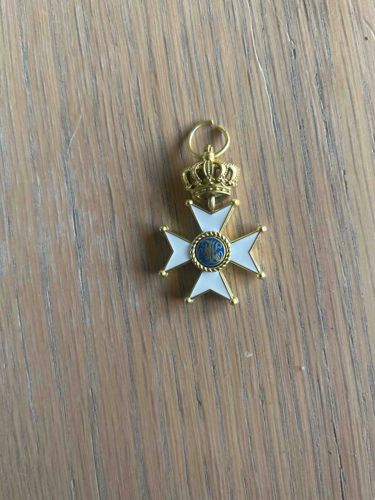
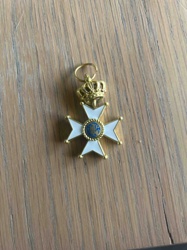
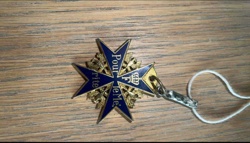
This item is a badge of the Military Order of Maria Theresa, one of the most prestigious military decorations of the Habsburg Monarchy. The badge features a white enameled Maltese cross with distinct gold-toned borders and small, precisely rendered golden spheres at each of its eight points. The central circular medallion is exquisitely enameled in a vibrant blue, prominently displaying a gold intertwined monogram "MT", representing Maria Theresa, the founder of the order. Above the cross, serving as its suspension, is a detailed and ornate representation of an imperial crown, crafted from the same gold-toned metal and featuring intricate detailing typical of such regalia. This crown is then connected to a simple, sturdy suspension ring.
The overall physical condition appears very good, with the white and blue enamel retaining their lustre and showing no obvious chips, cracks, or significant abrasions. The gold-toned metal parts are bright and seemingly well-preserved, suggesting minimal wear or careful handling. Without a scale, the exact dimensions are hard to ascertain, but it appears to be a standard size for a badge of this type, likely in the range of 3-5 centimeters in height. No specific manufacturer's marks or hallmarks are visible in the provided image, which is common for many orders of this period unless specifically looking at the reverse or edge under magnification.
Dating for such an item can be complex; while the order itself was founded in 1757 and continued until the dissolution of the Austro-Hungarian Empire in 1918, numerous official and unofficial reproductions, and even post-monarchy restrikes, exist. The pristine condition of this piece, particularly the vivid enamel and bright gilding, might suggest a more recent manufacture or a very well-preserved example, possibly a high-quality replica. However, the craftsmanship appears to be of a high standard, with clean lines and sharp details indicating quality production. Despite its Austrian origin, this order was frequently awarded to Hungarian officers and subjects during the era of the Austro-Hungarian Empire, making it historically relevant within a Hungarian context as well. The badge serves as a significant historical artifact, representing acts of extraordinary bravery and military merit within the former empire.
AI Appraisal Report
Upon my visual examination of the provided image, this Military Order of Maria Theresa, Knight's Cross Badge, presents in remarkably fine aesthetic condition. The white and blue enamelling retains its vividness and appears free from significant chips or cracks. The gold-toned metalwork is bright and shows minimal signs of wear, suggesting either careful handling or a more recent manufacture.
However, the pristine nature of the enamel and bright gilding, while visually appealing, immediately raises questions regarding its absolute authenticity for a piece potentially dating back centuries. High-quality reproductions of this prestigious order are common. Authentic, period-awarded Knight's Crosses are exceedingly rare and highly coveted, commanding values ranging from tens of thousands to well over a hundred thousand dollars, contingent on provenance and recipient history. In contrast, well-made reproductions, such as this appears to be, typically fall into a much lower value bracket.
This appraisal is strictly based on the provided image and description. A definitive assessment of authenticity, and thus value, cannot be made without a physical, in-person examination. Key verifications would include: microscopic examination for manufacturing characteristics, spectroscopic analysis of the metal for gold content and purity, precise weight verification, and a thorough search for hidden hallmarks. Provenance documentation linking it to a historical awardee would also be critical. Without such detailed authentication, and considering the prevalent market for reproductions, I must appraise this piece as a high-quality example of a later-period or collector's copy, albeit one exhibiting superior craftsmanship.