AI estimate as of October 19, 2025 · verify with a professional before acting
AI-Generated · Verify before acting
Everything on this page is generated by AI for informational purposes only. AI can make mistakes — the AI may misidentify items or misattribute them (artist, maker, brand, designer, origin, era). This is not an official valuation and should not be used for insurance, sale, tax, estate, legal, or lending purposes — or any decision requiring a certified appraisal. It is not an authoritative claim about any person, brand, or rights holder — do not share or rely on it as a factual statement about a third party. Always consult qualified professionals before making financial decisions.
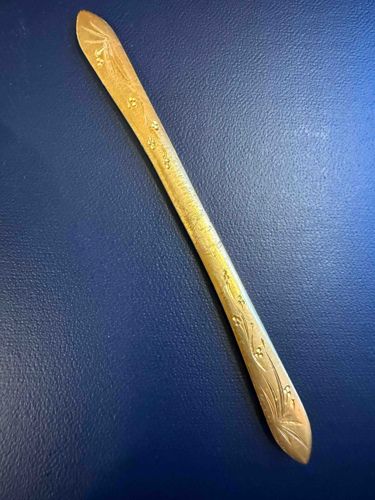
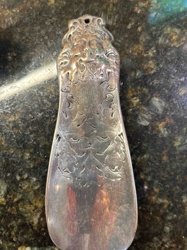
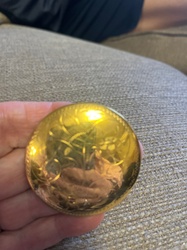
The item is an elongated, slender tool, typically known as a button hook, crafted from a gold-toned metal. Its overall shape is slightly curved along its length, with both ends tapering to a rounded point. The surface features intricate floral engravings, suggestive of an Art Nouveau or Aesthetic Movement aesthetic. These engravings depict delicate sprigs or vines with small, rounded flower or berry-like clusters distributed along the central ridge of the tool. The design appears to be continuous and consistently applied across the visible polished surface, indicating a decorative rather than purely utilitarian purpose. The color of the metal is a rich, warm yellow, characteristic of brass or gold-plated materials. There are no immediately visible maker's marks or signatures from the provided image, precluding identification of the specific manufacturer. The tool exhibits a subtle sheen, suggesting either a polished finish or a natural patina characteristic of older metallic items. Given the design motifs, the item likely dates from the late 19th to early 20th century. The craftsmanship appears to be of good quality, with clear etching despite what may be some general surface wear consistent with age and use, although no significant damage or repairs are discernible. Its narrow profile and elegant decoration imply it may have been used for fastening small buttons on clothing, shoes, or gloves, or perhaps as a desk accessory.
AI Appraisal Report
Based on my visual examination of the provided image, this Art Nouveau Era Button Hook, crafted from a gold-toned metal with intricate floral engravings, appears to be in good antique condition. The consistent floral motif, characteristic of the Art Nouveau or Aesthetic Movement, strongly supports its dating to the late 19th to early 20th century. The craftsmanship, with clear and continuous etching, suggests a well-made piece, likely brass or gold-plated, given the warm yellow tone.
While the item exhibits a subtle sheen, suggesting some wear consistent with age and use, there are no discernible significant damages, repairs, or losses. This good state of preservation positively impacts its value. However, the absence of any visible maker's marks or signatures limits the ability to attribute it to a specific, potentially more collectible, manufacturer, which would otherwise enhance its value significantly.
In terms of market conditions, antique button hooks, especially those with decorative elements, generally see steady but not exceptionally high demand. Comparables for similar gold-toned, decoratively engraved button hooks typically range from $30 to $80, with prices at the higher end usually reserved for sterling silver examples, those with specific identifiable makers, or more elaborate designs incorporating gemstones or unusual materials. This piece, while aesthetically pleasing, fits squarely within the common decorative category.
Rarity is relatively low for general decorative button hooks; myriad examples were produced during its likely era. Without specific provenance or unique design elements that distinguish it from the common varieties, it is unlikely to command a premium. Factors impacting its value negatively are primarily the commonality of the item type and the lack of maker identification. Its intrinsic material value (if brass) is negligible.
It is crucial to note the limitations of an image-based appraisal. Authenticity, particularly regarding the metal composition (e.g., gold-plated vs. solid brass), cannot be definitively confirmed without in-person examination. Physical inspection would allow for tactile assessment of material, closer scrutiny for microscopic maker's marks, and a precise evaluation of surface condition and potential repairs not visible in the photograph. Metallurgical testing would be required for absolute confirmation of material composition if a higher value hinged on it. Furthermore, a direct examination would confirm the depth and quality of the engraving. Without physical inspection, I must assume typical period manufacturing quality.