These notes were written by the person who submitted this item. Appraiser.AI has not verified them, and the AI's identification and estimate may rely on them.
AI Estimated Value
Not an official valuation
$10-35
AI estimate as of August 6, 2025 · verify with a professional before acting
AI-Generated · Verify before acting
Everything on this page is generated by AI for informational purposes only. AI can make mistakes — the AI may misidentify items or misattribute them (artist, maker, brand, designer, origin, era). This is not an official valuation and should not be used for insurance, sale, tax, estate, legal, or lending purposes — or any decision requiring a certified appraisal. It is not an authoritative claim about any person, brand, or rights holder — do not share or rely on it as a factual statement about a third party. Always consult qualified professionals before making financial decisions.
This analysis also relies on unverified notes provided by the user, which may be incomplete or inaccurate and could affect the result.
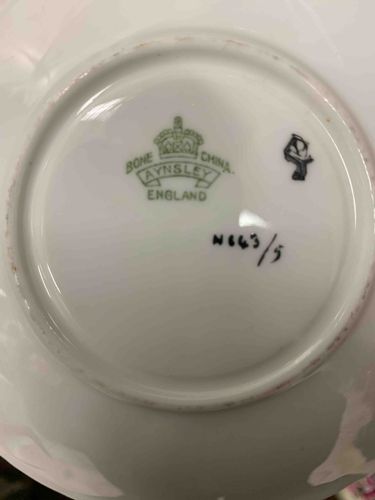
The item appears to be the underside of a bone china teacup or saucer, manufactured by Aynsley in England. The primary color is a pristine white, characteristic of high-quality bone china, which is known for its translucency and delicate appearance. The visible part of the item shows a raised footrim, indicating it is likely a saucer or a cup with a substantial base. The craftsmanship suggests a finely made piece, as expected from Aynsley, a renowned pottery company. The most notable features are the manufacturer's backstamp and an additional black mark. The backstamp is centrally located and reads "BONE CHINA," "AYNSLEY," and "ENGLAND," all enclosed within a decorative green crown motif. This specific mark, with the crown and the wording, is indicative of Aynsley's production between approximately 1934 and 1950, suggesting a mid-20th century style period. To the right of the main mark, there is a distinct black-inked symbol, which resembles a stylized 'S' or a manufacturer's decorator mark, possibly indicating a specific pattern series or a detail from the decorating department. Below the main backstamp, in black handwritten script, are the numbers "N663 / 5," which are likely pattern numbers, batch numbers, or internal inventory codes used by the manufacturer or a retailer. There appears to be a slight discoloration or light staining along the edge of the footrim, which could be minor wear, residual dirt, or a slight manufacturing imperfection. The overall condition, based on the visible portion, seems good, with no obvious chips, cracks, or significant wear visible on the back, suggesting it has been well-preserved. The bone china material itself signifies an item of higher quality due to its strength and bright white finish.
AI Appraisal Report
Upon examining the provided image of the underside of this Aynsley bone china piece, I can identify several key value-determining features. The backstamp, featuring a green crown with 'AYNSLEY', 'ENGLAND', and 'BONE CHINA', confidently dates this item to the 1934-1950 period, which is a desirable era for collectors. The handwritten script 'N663 / 5' is a pattern number, crucial for identification and valuation. Without seeing the pattern side, the value is speculative, as the desirability of Aynsley pieces is heavily dependent on the pattern's rarity and aesthetic appeal. Common floral patterns are plentiful, while more elaborate, hand-painted, or signed artist pieces command significantly higher prices.
The visible portion appears to be in good condition, with no apparent chips or cracks, although slight discoloration on the footrim is noted. Market conditions for mid-20th-century English bone china are generally soft, saturated with common patterns. However, rare or particularly beautiful patterns can still achieve strong results. The value of this item is contingent on whether it is a single saucer, a teacup, or part of a duo/trio, and most importantly, the specific 'N663' pattern. A single saucer from a common pattern holds minimal value, while a complete cup and saucer in a rare design could be worth more.
It is important to note that this appraisal is limited by the digital image. A definitive assessment of authenticity and condition requires in-person examination to check for hairline cracks, restoration, and to confirm the quality of the china and decoration. Verifying the pattern against Aynsley archives would confirm its specific name and rarity.