AI estimate as of August 11, 2025 · verify with a professional before acting
AI-Generated · Verify before acting
Everything on this page is generated by AI for informational purposes only. AI can make mistakes — the AI may misidentify items or misattribute them (artist, maker, brand, designer, origin, era). This is not an official valuation and should not be used for insurance, sale, tax, estate, legal, or lending purposes — or any decision requiring a certified appraisal. It is not an authoritative claim about any person, brand, or rights holder — do not share or rely on it as a factual statement about a third party. Always consult qualified professionals before making financial decisions.
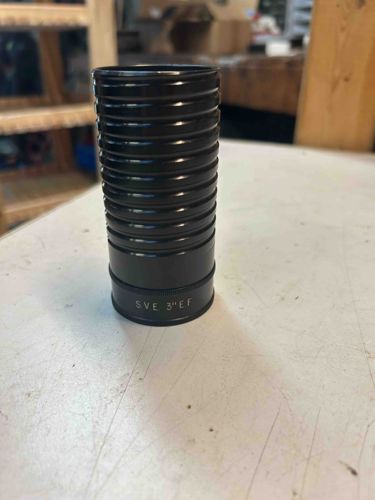
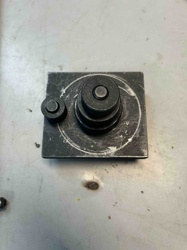
The item is a cylindrical optical lens or projection component, likely for a projector given its appearance and the visible 'EF' marking which often pertains to 'Extra Focal' or 'Extended Focus' lenses in projection systems. It is predominantly black with a matte or satin finish, suggesting an anodized aluminum or similar lightweight metal construction. The main body of the cylinder features a distinctive ribbed or grooved design composed of approximately 10-12 closely spaced, parallel, raised rings that run around the circumference. These rings provide a tactile grip and may also serve to dissipate heat or reduce internal reflections. The top and bottom ends appear smooth. Near the base, there's a smooth, unribbed section where white, etched or painted lettering is visible, stating "SVE 3" EF". This marking is likely the manufacturer's name or model identifier (SVE) and a focal length or specification (3" EF). The overall condition appears good with no significant visible damage, scratches, or wear marks that would suggest heavy use or mishandling. The surface appears clean, and the edges are well-defined, indicating good craftsmanship. Given the visible text and common designs for projection lenses, it likely dates from the mid to late 20th century. The quality of machining, particularly the consistent spacing and depth of the ribs, suggests a precision-made component characteristic of optical equipment.
AI Appraisal Report
Upon visual examination of the provided image, I assess this SVE 3" EF Projection Lens Component to be in very good condition. The matte black finish appears largely intact with no visible major scratches, dents, or signs of heavy wear. The distinctive ribbed design is well-defined, suggesting good original manufacturing quality and careful handling over time. The 'SVE 3" EF' marking is clear and legible, aiding in identification. Authenticity, based solely on the image, appears consistent with known SVE (Society for Visual Education, Inc.) optical components from the mid-to-late 20th century. However, definitive authentication would require an in-person examination to check for internal optics cleanliness, absence of fungus or haze, and mechanical integrity of any internal components. Provenance documentation, though unlikely for such a common item, would also strengthen authentication.
From a market perspective, vintage projection lenses like this are primarily sought after by collectors of vintage audio-visual equipment, enthusiasts restoring projectors, or sometimes for adaptation to modern cameras for creative photography (bokeh effects). The 'SVE' brand is recognized but not highly prized in comparison to brands like Bell & Howell or Kodak. Comparables on online marketplaces (eBay, specialty forums) for similar vintage projector lenses typically range from $15 to $50, depending on condition, brand, and focal length. The 3-inch focal length is common.
Demand for such specific, non-high-end vintage projector components is generally low, making it a niche market. This item is not rare; many such lenses were produced. Factors impacting value negatively include the specialized nature of the item, the lack of widespread collectibility for SVE lenses specifically, and the high availability of similar components. Without the original projector, its utility is limited for most consumers. The primary value drivers are its good cosmetic condition and its functionality for a specific vintage equipment user. No scientific testing is typically performed for such items unless there's a specific optical performance claim to verify.
My valuation is based on its clean cosmetic state and its specific utility to a small collector or restorer community.