AI Appraisal Estimate

AI-generated estimates · not official valuations

From the user

What was submitted

Photo and notes provided by the user — not generated by AI

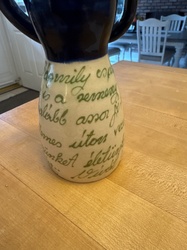
Submitted item photo
Submitted photo · May 19, 2026

User's notes

No additional notes provided.

AI analysis below

AI appraisal

AI analysis & estimate

AI-Generated · Verify before acting

Everything below is generated by AI for informational purposes only. AI can make mistakes — the AI may misidentify items or misattribute them (artist, maker, brand, designer, origin, era). This is not an official valuation and should not be used for insurance, sale, tax, estate, legal, or lending purposes — or any decision requiring a certified appraisal. It is not an authoritative claim about any person, brand, or rights holder — do not share or rely on it as a factual statement about a third party. Always consult qualified professionals before making financial decisions.

Read the full disclaimer

AI Identification

·Not independently authenticated·Verify before acting

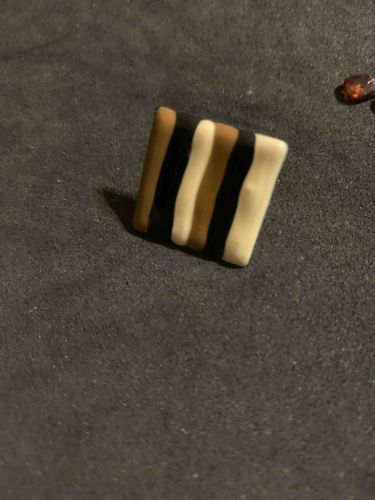
Modernist Striped Square Studio Pottery Tile

Art Pottery & Studio Ceramics

AI Estimated Value

·Not an official valuation·Verify before acting

$45.00-$75.00

As of May 19, 2026

AI Item Analysis

·AI can make mistakes·Verify before acting
This item is a small, hand-fashioned ceramic square tile, likely intended for use as a sculptural element, decorative insert, or component of a piece of jewelry such as a brooch or large ring face. The piece measures approximately 1 to 1.5 inches square. It is constructed from stoneware or polymer clay, featuring a distinct vertically striped pattern. The color palette consists of alternating earth tones including a muted tan-brown, charcoal black, and a creamy off-white. Each stripe has been applied or joined in a layered, hand-rolled fashion, resulting in a gentle three-dimensional ribbing or undulation rather than a perfectly flat surface. The edges are slightly irregular and hand-finished, indicating studio craftsmanship rather than industrial mass production. The finish is matte to semi-matte, displaying a natural, tactile quality without high-gloss glazing. In terms of condition, the item appears well-preserved with no significant chips or cracks visible on the display face; however, there is a minor irregularity or slight compression on the rightmost white band consistent with the curing or firing process. The style is mid-to-late 20th-century modernist, reflecting an organic, minimalist aesthetic characterized by geometric simplicity and neutral tones. There are no visible maker's marks on the upward-facing surface.
AI Appraisal Report

·AI can make mistakes·Verify before acting
I have carefully examined the provided images of this Modernist Striped Square Studio Pottery Tile. Measuring approximately 1 to 1.5 inches, this piece reflects a mid-to-late 20th-century 'earth-tone' aesthetic consistent with the studio pottery movement. The hand-fashioned stoneware exhibits a rhythmic, layered construction where individual coils of clay have been compressed to create a textured, linear pattern. The condition is excellent; the slight compression on the rightmost band appears to be a firing artifact rather than post-production damage, preserving its original artistic integrity. While the craftsmanship is competent and the aesthetic is appealingly minimalist, the absence of a maker’s mark or signature significantly impacts its valuation. Without an attribution to a known ceramicist like Lucie Rie or Hans Coper—whose works share this DNA but command five-figure sums—this remains a 'found object' studio piece. Market demand for unsigned modernist miniatures is currently stable but modest, often sought by collectors of jewelry components or Brutalist design accents. Comparable unsigned studio tiles typically sell in the $30-$80 range. Note: This appraisal is based strictly on visual digital analysis. Authenticity as a specific artist’s work cannot be verified via images alone. For a definitive valuation, an in-person examination is required to assess the weight and clay body density. Furthermore, definitive authentication would require provenance documentation (such as a gallery receipt or exhibition history) and possibly a spectroscopic analysis of the clay and slip composition to determine regional or chronological origin.

Get your items appraised

Instant estimates of your treasures with AI-powered appraisals

Browse More Appraisals