AI Appraisal Estimate

AI-generated estimates · not official valuations

From the user

What was submitted

Photo and notes provided by the user — not generated by AI

Submitted item photo
Submitted photo · May 18, 2026

User's notes

No additional notes provided.

AI analysis below

AI appraisal

AI analysis & estimate

AI-Generated · Verify before acting

Everything below is generated by AI for informational purposes only. AI can make mistakes — the AI may misidentify items or misattribute them (artist, maker, brand, designer, origin, era). This is not an official valuation and should not be used for insurance, sale, tax, estate, legal, or lending purposes — or any decision requiring a certified appraisal. It is not an authoritative claim about any person, brand, or rights holder — do not share or rely on it as a factual statement about a third party. Always consult qualified professionals before making financial decisions.

Read the full disclaimer

AI Identification

·Not independently authenticated·Verify before acting

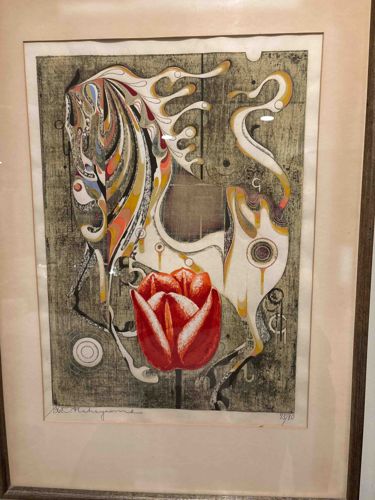
Tadashige Nakayama, Horse and Tulip Woodblock Print

Fine Art - Japanese Woodblock Prints

AI Estimated Value

·Not an official valuation·Verify before acting

$1,200-$1,800

As of May 18, 2026

AI Item Analysis

·AI can make mistakes·Verify before acting
This is an original polychrome woodblock print by the renowned Sosaku-hanga (creative print) artist Tadashige Nakayama (1927–2014). The artwork features a stylized, abstract horse rendered in Nakayama's signature ornate manner, characterized by flame-like, undulating lines and organic shapes reminiscent of the Art Nouveau movement combined with traditional Japanese aesthetics. The horse is depicted in profile with decorative swirls of gold, mustard yellow, earthy orange, and white, set against a dark, textured background showing a fine wood grain pattern. Centered at the base of the composition is a vibrant red tulip with white stippled highlights, providing a sharp color contrast. The print is hand-signed in pencil by the artist in the lower left margin and numbered 22/80 in the lower right, indicating a limited edition strike. The piece is housed in a contemporary wooden frame with a neutral-toned mat board. The condition appears fair to good; there is visible rippling or 'cockling' of the paper within the frame, suggesting moisture exposure or tension in the mounting. There are also distinct brownish age spots (foxing) visible particularly along the upper and left white margins, which are common for prints of this mid-to-late 20th-century period. Despite several minor condition issues, the colors remain saturated and the intricate layering technique characteristic of Nakayama’s high-quality craftsmanship is well-preserved.

AI Appraisal Report

·AI can make mistakes·Verify before acting
I have conducted a visual analysis of this original polychrome woodblock print by Tadashige Nakayama (1927–2014). The work displays the hallmarks of Nakayama’s mature style: a sophisticated integration of gold pigments, intricate texturing, and a unique synthesis of Persian-influenced ornamentation with Japanese Sosaku-hanga principles. Based on the signature style and the specific edition numbering (22/80), the piece appears authentic; however, a definitive authentication requires physical inspection of the paper's watermark and ink absorption which cannot be confirmed via digital image. Condition is a significant factor in this valuation. My examination notes visible cockling and moderate foxing in the margins. While the central image and colors remain vibrant, the presence of oxidation spots and paper distortion suggests environmental stress. These issues serve as a detractor from the 'near-mint' prices often seen at major auction houses, which for this specific subject matter—part of his highly sought-after horse series—can exceed $2,500. Market demand for Nakayama remains strong among global collectors of 20th-century Japanese prints, particularly for mid-sized editions that utilize metallic pigments. The rarity of this specific 'Horse and Tulip' composition, combined with the low edition number, maintains its desirability despite the noted condition flaws. To finalize this appraisal, I would require an in-person inspection to determine if the foxing has spread into the ink layers and to verify the mounting technique used behind the mat. Provenance documentation or a gallery seal from a reputable dealer would further solidify the valuation. Professional conservation to address the rippling and acidity in the paper would likely increase the market value by 20-30%.

Get your items appraised

Instant estimates of your treasures with AI-powered appraisals

Browse More Appraisals