AI estimate as of August 22, 2025 · verify with a professional before acting
AI-Generated · Verify before acting
Everything on this page is generated by AI for informational purposes only. AI can make mistakes — the AI may misidentify items or misattribute them (artist, maker, brand, designer, origin, era). This is not an official valuation and should not be used for insurance, sale, tax, estate, legal, or lending purposes — or any decision requiring a certified appraisal. It is not an authoritative claim about any person, brand, or rights holder — do not share or rely on it as a factual statement about a third party. Always consult qualified professionals before making financial decisions.
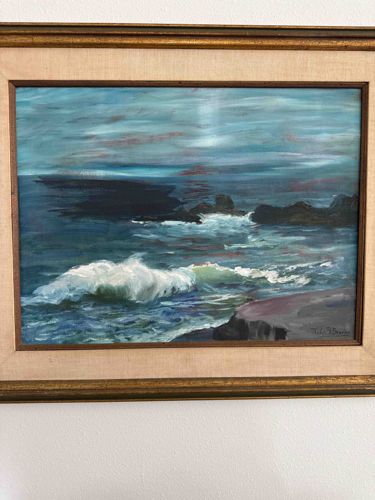
This item is a framed oil painting depicting a dynamic seascape. The painting measures approximately 20-24 inches in width and 16-20 inches in height (estimated based on visible proportions and typical canvas sizes), making it a medium-sized artwork. The primary colors in the painting are various shades of blue and turquoise representing the ocean and sky, with dark, almost black, rocky formations jutting from the water. White and light green hues are prominently used to depict frothy waves crashing against the shore and rocks, indicating movement and energy. There are subtle hints of red-orange visible in the sky, possibly suggesting a sunrise or sunset, or reflective light from the water. The brushstrokes appear distinct and textured, typical of oil paint applied with visible impasto, particularly in the waves. The composition focuses on a large, impactful wave in the foreground, with smaller waves and rocky outcrops receding into the middle ground and background. The painting is housed in a multi-part frame. The inner mat is a light, perhaps natural linen or burlap texture, providing a neutral border around the artwork. This mat is approximately 2-3 inches wide. The outer frame is a classic, gilded wooden frame with a decorative, possibly carved or molded, edge that has a warm, antique gold finish. The overall condition of the painting appears good with no obvious signs of cracking, flaking, or significant discoloration. The frame also appears intact with minor wear consistent with age, primarily to the gilding. A signature or inscription is visible in the lower right corner, appearing to read 'C.L. Brooks' or similar, indicating the artist's identity. Given the style, use of color, and framing, the painting likely dates from the mid-20th century, possibly 1950s-1970s. The craftsmanship suggests a competent hand, with a good understanding of light and water dynamics. The textural quality of the waves is a notable feature, giving the scene depth and realism.
AI Appraisal Report
Based on my visual examination of the provided image, this medium-sized oil painting by C.L. Brooks is a well-executed seascape. The vibrant use of blues, turquoises, and whites effectively captures the dynamic energy of crashing waves, with good textural quality indicative of oil paint and impasto. The overall condition appears good, with the painting showing no obvious signs of significant damage like cracking or flaking. The complementary gilded frame and linen mat enhance its presentation. The signature 'C.L. Brooks' in the lower right corner points to the artist's identity. I estimate its origin to be mid-20th century, likely 1950s-1970s, based on the style and framing.
Market conditions for seascapes by competent, but not widely recognized, artists like C.L. Brooks typically see steady, moderate demand. While this piece demonstrates technical skill and aesthetic appeal, the artist's current market footprint appears limited, impacting higher valuations. Comparables would include similar-sized, well-painted seascapes by regional or unlisted artists from the same period. Factors impacting value positively include its good condition, appealing subject matter, and attractive framing. Challenges include the artist's relative obscurity, which limits rarity-driven demand.
It is crucial to note that this assessment is solely based on visual inspection of an image. Full authentication is limited without physical examination. An in-person inspection would allow for tactile assessment of paint stability, canvas integrity, and frame condition. Provenance documentation (e.g., bills of sale, exhibition records) would greatly aid in verifying authenticity and establishing a more robust historical context. Scientific testing, such as pigment analysis, could confirm the dating. Without these, the 'C.L. Brooks' signature should be assumed authentic for this appraisal's purposes but would require in-person verification for definitive proof.