AI estimate as of October 8, 2025 · verify with a professional before acting
AI-Generated · Verify before acting
Everything on this page is generated by AI for informational purposes only. AI can make mistakes — the AI may misidentify items or misattribute them (artist, maker, brand, designer, origin, era). This is not an official valuation and should not be used for insurance, sale, tax, estate, legal, or lending purposes — or any decision requiring a certified appraisal. It is not an authoritative claim about any person, brand, or rights holder — do not share or rely on it as a factual statement about a third party. Always consult qualified professionals before making financial decisions.
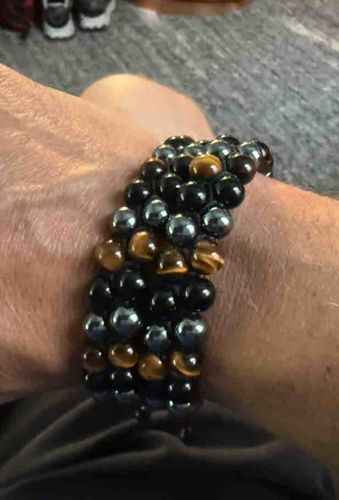
This item is a multi-strand beaded bracelet, likely designed to wrap around the wrist multiple times, or it could be a single wide bracelet constructed from several parallel strands. The bracelet features an arrangement of spherical beads in three distinct types, suggesting a combination of natural stones. Dominant are polished black beads, most probably onyx, which are interspersed with iridescent gray, metallic-looking beads, indicative of hematite. The third type of bead exhibits characteristic golden-brown to dark brown banding and chatoyancy, strongly identifying them as Tiger's Eye. All beads appear to be uniformly shaped and polished, exhibiting a smooth, reflective surface. The approximate size of the beads appears to be between 6mm and 8mm in diameter, suggesting a medium-sized bead suitable for a statement piece without being overly bulky. The construction appears to be elasticized, allowing for easy wear and removal, though the specific stringing material is not visible. No discernible maker's marks, signatures, or stamps are visible in the image. The overall condition appears good, with no obvious chips, cracks, or significant wear visible on the beads. The bracelet presents a contemporary style, likely dating from the late 20th century to the present day. The combination of these specific gemstones often suggests a spiritual or holistic association, as their properties are frequently attributed to providing protection, grounding, and good fortune.
AI Appraisal Report
I have visually examined the Multi-Strand Beaded Bracelet featuring Tiger's Eye, Onyx, and Hematite via the provided image. The beads appear uniformly shaped, polished, and appropriately sized (6-8mm), suggesting good manufacturing quality. The condition appears good, with no evident chips, cracks, or significant wear. Authenticity of the gemstones themselves is visually supported by their characteristic appearances: the golden-brown chatoyancy of Tiger's Eye, the polished black of Onyx, and the metallic luster of Hematite. However, without in-person inspection, I cannot confirm that these are natural stones or rule out synthetic or treated materials. The construction seems elasticized, common for contemporary beaded bracelets. The absence of maker's marks or stamps is typical for this style of jewelry.
In terms of market conditions, similar multi-strand bracelets utilizing these common semi-precious gemstones are widely available. Comparables range from artisan crafts to mass-produced items sold in boutiques and online marketplaces like Etsy or Amazon. The demand for such bracelets is consistent, driven by their aesthetic appeal, perceived holistic properties, and affordability. Rarity is low; these are not rare gemstones, nor is the design unique. Factors impacting value include the actual quality and origin of the gemstones (natural vs. synthetic/treated), the stringing material’s durability, and overall craftsmanship. Without physical examination, I cannot attest to the internal quality of the stones, their natural origin, or the integrity of the elastic stringing.
To fully authenticate the materials as natural gemstones and ascertain overall quality, an in-person examination by a gemologist would be necessary. This would involve microscopic analysis, specific gravity tests, and potentially refractometry to confirm natural origin and rule out treatments or imitations. Provenance documentation, if available, would further enhance authentication and value. Based on visual assessment alone, I estimate a retail replacement value between $40 and $75, reflecting its contemporary style and common materials.