AI estimate as of August 23, 2025 · verify with a professional before acting
AI-Generated · Verify before acting
Everything on this page is generated by AI for informational purposes only. AI can make mistakes — the AI may misidentify items or misattribute them (artist, maker, brand, designer, origin, era). This is not an official valuation and should not be used for insurance, sale, tax, estate, legal, or lending purposes — or any decision requiring a certified appraisal. It is not an authoritative claim about any person, brand, or rights holder — do not share or rely on it as a factual statement about a third party. Always consult qualified professionals before making financial decisions.
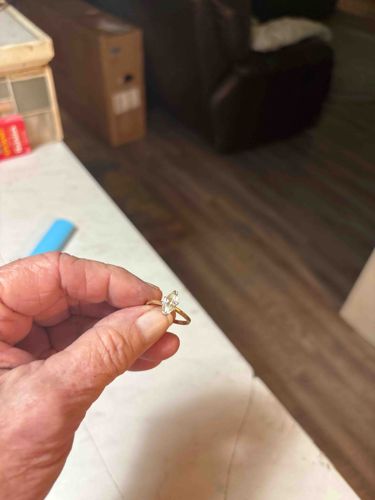
The item is a gold-toned ring featuring a single, prominent marquise-cut gemstone, likely a diamond or a diamond simulant, held in a four-prong setting. The stone exhibits notable brilliance and appears to be well-faceted, suggesting good optical properties. The band of the ring is a simple, polished gold color, indicating it could be yellow gold or a similar alloy. The setting appears to be a classic Tiffany-style or solitaire design, allowing maximum light to enter the stone. There are no visible maker's marks or distinguishing hallmarks in the provided image. The ring appears to be in good overall condition with no obvious signs of significant wear, chips, or damage to the stone. The metal band also appears smooth with a consistent finish, though minor surface scratches typical of normal wear might be present but are not discernible from the image resolution. The estimated age cannot be precisely determined without further hallmarks or historical context, but the marquise cut was very popular in the mid-20th century, particularly from the 1960s to 1980s, and continues to be a classic choice. Its simplicity and focus on the central stone suggest a timeless design. The craftsmanship appears to be of standard quality for mass-produced or semi-custom jewelry, with the prongs securely holding the stone. The size of the stone is substantial, making it a prominent piece of adornment.
AI Appraisal Report
Based on my visual examination of the provided image, this Marquise-Cut Solitaire Ring presents as a well-maintained piece. The gold-toned band appears in good condition, showing no obvious signs of significant wear or damage. The marquise-cut gemstone, likely a diamond or simulator, exhibits good brilliance and faceting, indicative of strong optical properties. Its four-prong setting is classic and secure, maximizing light entry. The authenticity of the gemstone and metal cannot be definitively confirmed without in-person examination; visual assessment alone cannot distinguish a natural diamond from a simulant or a specific gold karat from other alloys. Therefore, this appraisal is provisional.
Market conditions for solitaire rings remain consistently strong, particularly for classic designs. Marquise cuts, while less common than round brilliants, maintain a steady demand, appealing to those seeking a unique yet elegant aesthetic. The ring's substantial stone size adds to its prominence and perceived value. Factors significantly impacting value include the actual carat weight, color, clarity, and cut of the stone, none of which can be accurately assessed from an image. Similarly, the specific metal type (e.g., 14K, 18K yellow gold) and its weight are unknown.
For full authentication and a precise valuation, an in-person examination is crucial. This would involve specific gravity testing, refractive index measurements, and spectroscopic analysis for gemstone identification, as well as hallmark verification, scratch testing, or XRF analysis for metal composition. Provenance documentation, if available, could also provide valuable historical and ownership context.