AI Appraisal Estimate

AI-generated estimates · not official valuations

From the user

What was submitted

Photo and notes provided by the user — not generated by AI

Submitted item photo
Submitted photo · June 8, 2026

User's notes

No additional notes provided.

AI analysis below

AI appraisal

AI analysis & estimate

AI-Generated · Verify before acting

Everything below is generated by AI for informational purposes only. AI can make mistakes — the AI may misidentify items or misattribute them (artist, maker, brand, designer, origin, era). This is not an official valuation and should not be used for insurance, sale, tax, estate, legal, or lending purposes — or any decision requiring a certified appraisal. It is not an authoritative claim about any person, brand, or rights holder — do not share or rely on it as a factual statement about a third party. Always consult qualified professionals before making financial decisions.

Read the full disclaimer

AI Identification

·Not independently authenticated·Verify before acting

Ceramic Swan Planter/Vase

Decorative Arts

AI Estimated Value

·Not an official valuation·Verify before acting

$25-50

As of June 8, 2026

AI Item Analysis

·AI can make mistakes·Verify before acting
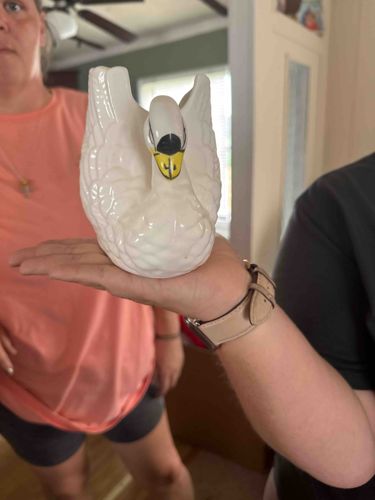
This item is a decorative ceramic piece, likely functioning as a planter or vase, sculpted in the form of a swan. It appears to be made of glazed ceramic or pottery, exhibiting a glossy white finish over most of its body, simulating the natural color of a swan's feathers. The texture on the body and wings is molded to depict individual feathers, adding a realistic tactile element to the design. The swan's head is upright with a black and yellow beak, detailed with painted black eyes and a yellow upper beak that has a small black accent mark, suggesting nostrils or a unique pattern. The shape suggests an opening at the back, between the raised wings, which would serve as the container's cavity. The size seems to be moderate, fitting comfortably in an adult's hand as shown in the image, implying it's suitable for small plants, flowers, or purely as an ornamental piece. There are no immediately visible signs of cracks, chips, or significant damage, and the glaze appears intact and evenly applied. The style suggests it could be from the mid to late 20th century, a common period for such ceramic novelties. The craftsmanship appears to be of good quality, with clear detailing on the feathers and facial features. Without clearer images of the base or interior, maker's marks are not discernible.
AI Appraisal Report

·AI can make mistakes·Verify before acting
Upon visual examination of the provided image, this ceramic swan planter/vase appears to be in very good overall condition. The glossy white glaze is intact, and there are no immediately visible chips, cracks, or significant abrasions. The molded feather detailing is crisp, and the painted facial features (eyes, beak) are well-defined and show no apparent wear. The lack of visible damage suggests careful handling over its lifespan. Authenticity, based solely on imagery, points to a mass-produced decorative ceramic from the mid to late 20th century, consistent with similar novelty items from that era. These pieces were widely available and not typically associated with high-end or collectible manufacturers unless marked by a well-known studio potter. While the craftsmanship is good for its type, it does not suggest a rare or artisanal origin. Market conditions for such vintage ceramic planters are generally stable but modest. Demand is primarily from collectors of vintage home decor, cottage-core enthusiasts, or individuals seeking charming accent pieces. Rarity is low; many similar swan-themed ceramic items were produced. Factors impacting value are primarily condition and aesthetic appeal, both of which are positive here. However, the commonality and lack of discernible provenance or maker's marks limit its top-tier value. Limitations in authenticity verification are significant. Without a physical in-person examination, I cannot confirm the exact ceramic type, assess interior condition for staining/wear, or search for maker's marks on the base. Provenance documentation, if available, could link it to a specific manufacturer or past owner, potentially increasing value if from a notable source. Scientific testing is not typically required for items of this nature unless there were questions about the material composition or age that would impact a higher valuation.

Get your items appraised

Instant estimates of your treasures with AI-powered appraisals

Browse More Appraisals