AI estimate as of November 6, 2025 · verify with a professional before acting
AI-Generated · Verify before acting
Everything on this page is generated by AI for informational purposes only. AI can make mistakes — the AI may misidentify items or misattribute them (artist, maker, brand, designer, origin, era). This is not an official valuation and should not be used for insurance, sale, tax, estate, legal, or lending purposes — or any decision requiring a certified appraisal. It is not an authoritative claim about any person, brand, or rights holder — do not share or rely on it as a factual statement about a third party. Always consult qualified professionals before making financial decisions.
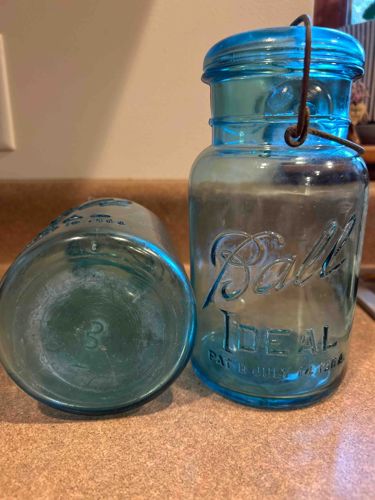
This image displays two vintage Ball Ideal canning jars, both crafted from a distinctive blue-green (aqua) tinted glass. The jar on the right is standing upright, showcasing its cylindrical body, rounded shoulders, and a wired-bail closure mechanism. The wire bail, which appears to be original and made of a dark, likely rusted or patinated metal, secures a matching blue-green glass lid. The front of this jar prominently features the embossed 'Ball' logo in a script font, with 'IDEAL' embossed beneath it in block letters. Below 'IDEAL', the text 'PAT' D JULY 14, 1908' is visible, indicating a patent date and thus providing a clue to its estimated age. The glass has characteristic bubbles and inconsistencies typical of early 20th-century glass manufacturing, suggesting a hand-blown or early machine-made process. The jar on the left is positioned on its side, revealing its base. The bottom of the jar also exhibits an embossed letter 'B', likely a mold mark or a manufacturer’s indication. Both jars show signs of age and use, including some haziness or mineral deposits on the interior and exterior surfaces, a common occurrence with glassware used for canning or storage over many decades. The wire bail on the upright jar shows rust development, contributing to its aged aesthetic. The overall condition suggests that while they are antiques, they appear structurally sound without major chips or cracks visible in the provided image. The vibrant blue-green color is a defining characteristic, often associated with specific periods of Ball jar production. These jars are popular among collectors for their historical significance, aesthetic appeal, and functional design.
AI Appraisal Report
I have examined the image provided depicting two vintage Ball Ideal canning jars. Based on my visual assessment, these jars appear authentic, consistent with Ball Ideal jars from the early 20th century, specifically indicated by the 'PAT'D JULY 14, 1908' embossing, which places their production around or after this date. The aqua-tinted glass, characteristic bubbles, and wired-bail closures with matching glass lids are all typical features of these desirable collectibles. The embossed 'Ball' script and 'IDEAL' block lettering further confirm their identity.
In terms of condition, both jars show visible signs of age and use, which is expected for items of this vintage. The haziness or mineral deposits suggest they were actively used for canning or storage. The rust on the wire bail of the upright jar adds to its antique character but doesn't detract significantly unless it compromises functionality. No major chips or cracks are apparent from the image, which is a positive factor. The embossed 'B' on the base of the jar on its side is likely a mold mark.
Market conditions for vintage Ball Ideal jars are generally steady. While common variations are readily available, the aqua tint and good condition with original closures make these more appealing to collectors. Comparables on online marketplaces and at antique shows typically see these jars range from $15-$30 each, depending on size, condition, and specific markings. The pair, being consistent in style and condition, adds a slight premium.
Demand for these jars is consistent among canning jar collectors, antique enthusiasts, and those seeking rustic decorative items. They are not exceedingly rare, but specific desirable variations or pristine examples can command higher prices. These particular jars fall into a good, solid collector's piece category.
Factors impacting value include their authentic vintage appearance, the appealing aqua glass color, and seemingly good structural integrity. Limitations in authenticating exclusively from images include the inability to inspect for hairline cracks, chips around the rim that might be obscured, or to fully assess the integrity of the wire bails and glass lids in hand. A physical examination would allow for a complete appraisal of structural soundness and to confirm the absence of any hidden damage or repairs that could impact value.