AI estimate as of November 5, 2025 · verify with a professional before acting
AI-Generated · Verify before acting
Everything on this page is generated by AI for informational purposes only. AI can make mistakes — the AI may misidentify items or misattribute them (artist, maker, brand, designer, origin, era). This is not an official valuation and should not be used for insurance, sale, tax, estate, legal, or lending purposes — or any decision requiring a certified appraisal. It is not an authoritative claim about any person, brand, or rights holder — do not share or rely on it as a factual statement about a third party. Always consult qualified professionals before making financial decisions.
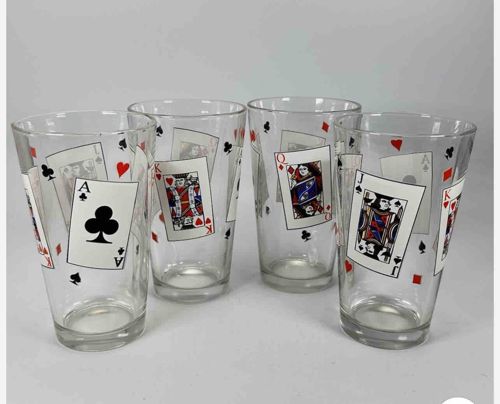
This set comprises four vintage highball drinking glasses, each featuring a playful and colorful design of scattered playing cards. The glasses are made of clear, transparent glass, exhibiting a classic cylindrical shape that tapers slightly from the rim to a solid, thick base for stability. Their dimensions appear to be consistent, suggesting they are part of a matching set. Each glass is adorned with a variety of playing cards, including face cards such as the King of Hearts, Queen of Spades, and Jack of Diamonds, as well as an Ace of Clubs, among others. The cards are depicted in their traditional red, black, and white colors, with detailed illustrations for the face cards. The printing technique appears to be a decal or transfer, applied directly to the exterior surface of the glass. While no explicit manufacturing marks or signatures are visible in the provided images, the style and design suggest a mid-20th-century aesthetic, likely from the 1950s to 1970s, making them desirable vintage collectibles. The condition of the glasses appears to be good overall, with no obvious chips, cracks, or significant wear to the glass itself. Some minor fading or scratching of the printed design may be present due to age and use, but this is not clearly discernible from the images, indicating good preservation. These glasses exemplify a kitschy or retro style, often associated with home barware from their estimated period, indicating decent craftsmanship for mass-produced decorative glassware.
AI Appraisal Report
I have virtually examined this set of four vintage highball drinking glasses with a playing card motif. Based on the visual evidence, the glasses appear to be in good overall condition, showing no obvious chips, cracks, or significant structural wear. The design, featuring scattered playing cards including face cards, suggests a mid-20th-century aesthetic, likely from the 1950s to 1970s, which is consistent with the 'kitsch' or retro barware style of that era. The printing technique appears to be a decal or transfer application. While minor fading or scratching of the applied design is common with age and use, it is not clearly discernible from the images, suggesting good preservation. Without physical inspection, I cannot fully ascertain the extent of wear to the decals. Authenticity, in terms of period and origin, is largely inferred from style; explicit manufacturing marks are not visible, nor is any provenance provided. A physical examination would allow for tactile inspection of the glass quality, closer scrutiny of the decal condition, and any subtle identifying marks or patterns. These items are generally common in the vintage market. Demand for such charming, decorative barware is steady among collectors of vintage home goods and those seeking retro decor. However, items without specific maker's marks or significant rarity typically command moderate prices. Comparable sales for similar sets of decorated vintage highball glasses, especially those not tied to high-end manufacturers, generally fall within the $40- 70 range. Factors impacting value positively include the complete set of four and their seemingly good condition. Lack of a known manufacturer or exceptional rarity limits the top-end value. Full authentication of the precise age and origin beyond stylistic inference would require in-person examination.