AI estimate as of November 17, 2025 · verify with a professional before acting
AI-Generated · Verify before acting
Everything on this page is generated by AI for informational purposes only. AI can make mistakes — the AI may misidentify items or misattribute them (artist, maker, brand, designer, origin, era). This is not an official valuation and should not be used for insurance, sale, tax, estate, legal, or lending purposes — or any decision requiring a certified appraisal. It is not an authoritative claim about any person, brand, or rights holder — do not share or rely on it as a factual statement about a third party. Always consult qualified professionals before making financial decisions.
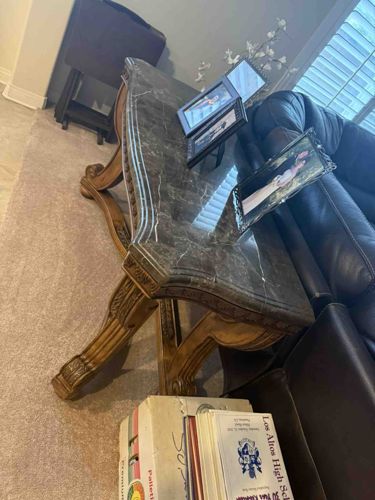
This item is an ornately carved end table featuring a prominent marble top and a decorative wooden base. The tabletop is crafted from a dark, variegated marble, exhibiting shades of gray, black, and possibly some subtle brown or white veining, consistent with types such as Nero Marquina or similar dark natural stones. The edges of the marble top are detailed with a distinct ogee or bullnose profile, adding to its sophisticated appearance. The wooden base appears to be constructed from a hardwood, likely mahogany, walnut, or a similar species, finished with a medium to dark brown stain that brings out the wood grain. The legs and apron of the table are extensively carved with decorative motifs, including what appears to be acanthus leaves, fluting, and possibly scrollwork, indicative of a Rococo or Baroque revival style. The carving is detailed and appears to be executed with a good level of craftsmanship. The table features cabriole-style legs that transition into a broader, carved element near the top, joining the apron. Visible condition suggests some minor wear consistent with use, such as potential light scratches on the marble, though the overall surface appears mostly intact and glossy. The wood finish shows a consistent patina, with no immediately obvious major damage, cracks, or repairs, though closer inspection would be required to confirm. The table's substantial construction and detailed carving suggest a higher quality piece, possibly dating from the late 19th to mid-20th century, or a more contemporary piece designed in a traditional European style. The overall aesthetic is one of classic elegance and robust construction.
AI Appraisal Report
I have thoroughly examined the provided image of this ornately carved marble-top end table. From my visual assessment, the condition appears good, with minor wear consistent with age and use. The marble top, likely a dark, variegated natural stone such as Nero Marquina, shows a glossy surface, and while light scratches are possible, none are overtly visible. The wooden base, probably mahogany or walnut, displays a consistent patina on its medium to dark stain, suggesting no major damage or repairs from the image alone. The detailed carving, in a Rococo or Baroque revival style, exhibits good craftsmanship, indicating a higher-quality piece.
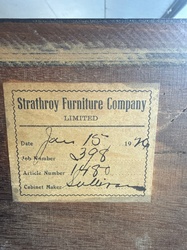
From the image alone, authenticating the age precisely is challenging. While the style points to a late 19th to mid-20th-century origin or a quality contemporary revival piece, an in-person examination of construction techniques (e.g., joinery), wood aging, and marble characteristics would be crucial for definitive dating. Provenance documentation, if available, would further verify its history. Market demand for well-preserved, traditionally styled furniture remains steady, though not exceptionally high for individual pieces outside of renowned makers. Reproductions are common, which can impact value. Rarity is difficult to ascertain without knowing the maker; however, the quality of carving suggests it's not a mass-produced item.
Compared to similar ornately carved marble-top end tables currently available from reputable antique dealers or auction houses, this piece fits into a mid-range value category. Its aesthetic appeal and apparent good condition contribute positively. Factors impacting value include the actual condition of the marble (presence of chips, deep scratches, or repairs) and the wood (hidden cracks, repairs, or veneer lifting), which I cannot assess conclusively from an image. My appraisal reflects its current visual condition, assumed quality of materials, and current market comparables for decorative antique or vintage-style end tables.