AI Appraisal Estimate

AI-generated estimates · not official valuations

From the user

What was submitted

Photo and notes provided by the user — not generated by AI

Submitted item photo
Submitted photo · May 23, 2026

User's notes

No additional notes provided.

AI analysis below

AI appraisal

AI analysis & estimate

AI-Generated · Verify before acting

Everything below is generated by AI for informational purposes only. AI can make mistakes — the AI may misidentify items or misattribute them (artist, maker, brand, designer, origin, era). This is not an official valuation and should not be used for insurance, sale, tax, estate, legal, or lending purposes — or any decision requiring a certified appraisal. It is not an authoritative claim about any person, brand, or rights holder — do not share or rely on it as a factual statement about a third party. Always consult qualified professionals before making financial decisions.

Read the full disclaimer

AI Identification

·Not independently authenticated·Verify before acting

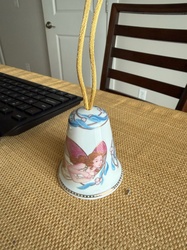
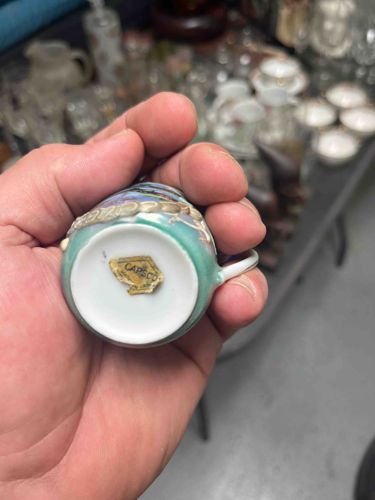
CAPSCO Miniature Porcelain Lustreware Cup

Collectibles - Vintage Porcelain & Ceramics

AI Estimated Value

·Not an official valuation·Verify before acting

$10.00-$15.00

As of May 23, 2026

AI Item Analysis

·AI can make mistakes·Verify before acting
This is a vintage miniature porcelain teacup or espresso cup, likely part of a souvenir or novelty set. The item is constructed from fine white porcelain and features a distinctive iridescent lustreware finish in shades of seafoam green and soft blue on the exterior body. A notable relief or 'moriage-style' raised beaded decoration forms a wavy band around the upper portion of the cup, accented with gold-tone or bronze-colored highlights. The handle is slender and finished in a plain white glaze, contrasting with the colorful body. On the underside of the base, there is a prominent gold foil sticker with black lettering that reads 'CAPSCO MADE IN JAPAN,' identifying the manufacturer as CAPSCO, a known mid-20th-century Japanese exporter. The base is an unglazed foot ring surrounding a glazed white center. In terms of condition, the piece appears to be in good vintage shape with no visible cracks or large chips from this angle. The foil label shows significant wear, peeling, and discoloration, which is typical for its estimated age (circa 1950s-1960s). The lustre glaze remains vibrant, though minor surface wear or 'flea bites' may be present upon closer tactile inspection. The craftsmanship reflects typical Japanese export quality from the post-war era, prioritizing decorative shelf appeal and novelty value.
AI Appraisal Report

·AI can make mistakes·Verify before acting
I have examined the CAPSCO Miniature Porcelain Lustreware Cup via the provided visual description and imagery. This piece is a classic example of post-WWII Japanese export novelty-ware, likely dating to the 1950s or 1960s. The identification of the 'CAPSCO' foil label is a primary marker for authenticity; the wear on the label is consistent with the age and the transient nature of adhesive labels from this era. The lustreware finish and moriage-style relief work remain vibrant, which is the primary driver of its decorative appeal. Market conditions for mid-century Japanese miniature ceramics are currently soft, as these items were mass-produced in high volumes for the souvenir trade. Comparables for individual miniature cups of this type typically sell for nominal amounts, as they are most desirable when part of a complete set with a matching saucer. The value is strictly decorative and sentimental rather than investment-grade. While the item appears to be in good vintage condition, a physical inspection is required to check for 'flea bites' on the rim or hairline fractures that are not visible in photographs. Furthermore, a tactile examination of the porcelain density would be necessary to distinguish this from later secondary reproductions, though the authentic foil sticker provides high confidence in its origin. For a full certificate of authenticity, provenance regarding the original purchase or a laboratory test of the glaze's mineral content would be necessary, though the cost of such testing would far exceed the market value of the object.

Get your items appraised

Instant estimates of your treasures with AI-powered appraisals

Browse More Appraisals