These notes were written by the person who submitted this item. Appraiser.AI has not verified them, and the AI's identification and estimate may rely on them.
AI Estimated Value
Not an official valuation
$1 - $3
AI estimate as of August 3, 2025 · verify with a professional before acting
AI-Generated · Verify before acting
Everything on this page is generated by AI for informational purposes only. AI can make mistakes — the AI may misidentify items or misattribute them (artist, maker, brand, designer, origin, era). This is not an official valuation and should not be used for insurance, sale, tax, estate, legal, or lending purposes — or any decision requiring a certified appraisal. It is not an authoritative claim about any person, brand, or rights holder — do not share or rely on it as a factual statement about a third party. Always consult qualified professionals before making financial decisions.
This analysis also relies on unverified notes provided by the user, which may be incomplete or inaccurate and could affect the result.
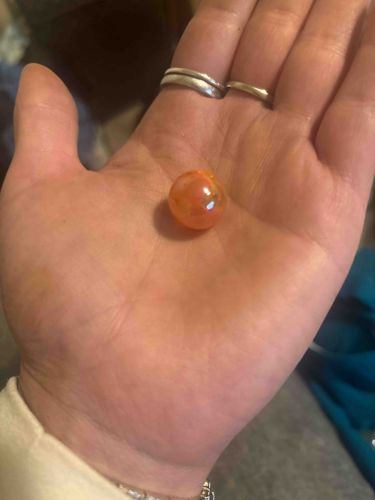
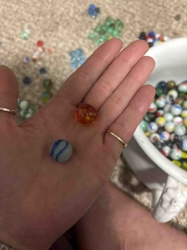
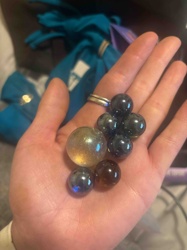
The item is a machine-made marble, approximately 0.6 to 0.7 inches (15-18mm) in diameter, consistent with a 'shooter' size or a standard playing marble. Its primary coloration is a translucent to semi-translucent orange, with an internal swirl or patch of a darker, possibly olive-green or deep brown hue, concentrated in one area. This internal coloring has an irregular, organic shape, suggestive of a molten glass inclusion rather than a precise pattern. The surface appears to be made of glass, exhibiting a glossy, reflective finish. There are visible points of light reflection on its surface, indicating its spherical shape and smooth texture. The overall condition appears good, with no obvious chips, cracks, or significant abrasions visible from the provided image. The transparency of the orange glass allows some light to pass through, highlighting the internal darker inclusion. Given its polished, uniform spherical shape and the nature of the internal color application, it is almost certainly a mass-produced item. While precise age and manufacturer cannot be determined from the image alone, this style of marble, with its mixed translucent colors, was commonly produced from the mid-20th century onwards. The craftsmanship is typical of machine-made glass marbles, showing good symmetry and a consistent surface.
AI Appraisal Report
I have examined the provided image of the translucent orange and green swirl glass marble, along with the detailed description. Based on my visual assessment, the marble appears to be machine-made, consistent with standard 'shooter' sizes (0.6 to 0.7 inches). Its condition seems good, showing typical gloss and smoothness for a glass marble, without visible chips, cracks, or significant abrasions in the image. The internal irregular swirl of darker green within the translucent orange glass is also typical of machine-made production, where molten glass colors are introduced.
Authenticity: From the image, the marble appears to be an authentic glass marble of the type described. However, full authentication for unique characteristics or manufacturer identification cannot be definitively confirmed without in-person examination. Physical inspection would allow me to assess the exact weight, feel the surface for any subtle imperfections not visible, confirm the precise coloration under different lighting, and look for pontil marks or specific manufacturing clues. Provenance documentation, such as original packaging or verifiable purchase records, would also be invaluable, though unlikely for a common marble.
Market Conditions & Comparables: The market for common machine-made glass marbles is generally stable but low-value. While attractive, this marble does not exhibit characteristics typically associated with rare or highly sought-after collectible marbles (e.g., iridescent finishes, complex internal lampwork, or known rare manufacturer patterns like certain Akro Agate or Peltier Glass). Comparable marbles, especially those without specific manufacturer identification, typically retail for modest amounts.
Demand & Rarity: There is general demand for machine-made marbles among collectors, but this particular style is not rare. The orange and green translucent swirl is a common combination found across various manufacturers from the mid-20th century onwards. The lack of identifiable unique features or historical significance limits its premium value.
Factors Impacting Value: The primary factors affecting value here are its common machine-made nature, lack of rarity, and the absence of clear manufacturer identification. While its good condition is a positive, it's not enough to elevate its value significantly. Any chips, cracks, or significant surface damage would drastically reduce its value. Conversely, if it were definitively identified as a rare variation from a renowned manufacturer, its value could increase, but this is not suggested by the current information.
In summary, based solely on the provided image and description, this is a pleasing but common example of a machine-made glass marble.