AI estimate as of October 3, 2025 · verify with a professional before acting
AI-Generated · Verify before acting
Everything on this page is generated by AI for informational purposes only. AI can make mistakes — the AI may misidentify items or misattribute them (artist, maker, brand, designer, origin, era). This is not an official valuation and should not be used for insurance, sale, tax, estate, legal, or lending purposes — or any decision requiring a certified appraisal. It is not an authoritative claim about any person, brand, or rights holder — do not share or rely on it as a factual statement about a third party. Always consult qualified professionals before making financial decisions.
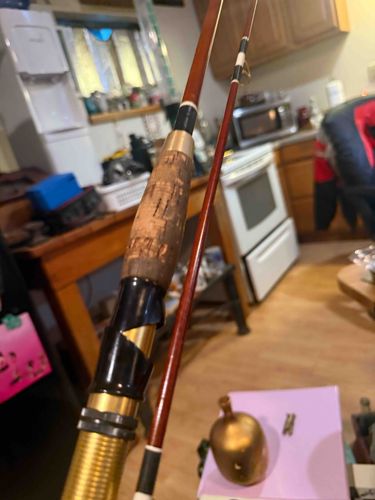
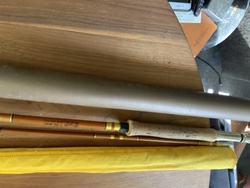
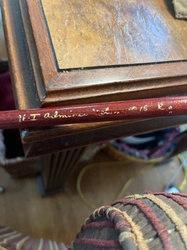
The item is a vintage-style fishing rod, likely designed for spinning or light tackle applications. Its primary physical characteristics feature a reddish-brown rod blank, which appears to be constructed from fiberglass or bamboo, judging by the warm tone and slight translucence visible in some areas. The handle section is particularly distinctive: it features a cork grip, showing significant wear, discoloration, and small missing pieces, indicating prolonged use and age. Below the cork handle, there's a reel seat, which is predominantly brass or a brass-toned metal, characterized by a ribbed, threaded lower section designed to secure a fishing reel. Above the threaded portion, the reel seat transitions into a black component that has been wrapped or partially repaired with black electrical tape, suggesting a potential point of weakness or a previous repair endeavor. A golden-colored ferrule or decorative band separates the cork grip from the black section of the reel seat. Further down the rod blank, there are black and white wraps indicating guides, although the guides themselves are not clearly visible. The overall condition suggests a well-used item, possibly from the mid-20th century, given the materials and construction style. The visible wear on the cork and the apparent repair on the reel seat are notable condition issues. No clear manufacturing marks or logos are discernible from the provided images, which makes precise dating or maker identification challenging without further inspection. The craftsmanship appears functional, consistent with a utilitarian fishing tool, but details like the reel seat’s material suggest a certain level of quality in its original manufacture.
AI Appraisal Report
I have examined the provided image of this vintage-style fishing rod. My assessment indicates a well-used item, likely dating from the mid-20th century, based on the reddish-brown blank material (suggesting fiberglass or possibly bamboo) and the classic cork grip and metal reel seat design. Authenticity as a vintage piece appears strong, given the materials and construction characteristics visible, though precise age and maker cannot be definitively confirmed without physical inspection.
The condition is fair to poor, significantly impacted by the wear on the cork grip (discoloration, missing pieces) and the notable black electrical tape repair on the reel seat. These factors detract considerably from its aesthetic appeal and structural integrity, negatively affecting value. The brass-toned reel seat, despite the repair, suggests a period of manufacturing where quality components were often used. However, without clear manufacturing marks or a brand name, its origin and specific model remain unknown, which limits its appeal to dedicated collectors.
In terms of market conditions, vintage fishing rods are a niche market. While high-end, rare, or famous maker rods can fetch significant prices, utilitarian rods in this condition, without identifiable provenance or brand, typically command lower values. Comparable sales for similar unmarked, well-used vintage rods suggest a modest market. Demand for this specific item is likely low due to its condition and lack of identifying features. Its rarity is difficult to ascertain, but without a brand, it's unlikely to be uniquely rare.
Key factors significantly impacting its value are the extensive wear on the cork handle, the visible repair on the reel seat, and the absence of any discernible maker's marks. For a full authentication, in-person examination would be critical to assess the blank material (e.g., bamboo vs. fiberglass), inspect the reel seat repair more thoroughly, and search for any hidden markings. Provenance documentation, such as original sales receipts or owner history, would also greatly enhance its value and historical completeness.
Given these considerations, I appraise this vintage spinning rod at a value of $30-70. This reflects its status as a vintage, functional artifact with notable condition issues and a lack of specific collector interest without further identification.