These notes were written by the person who submitted this item. Appraiser.AI has not verified them, and the AI's identification and estimate may rely on them.
AI Estimated Value
Not an official valuation
$50 - $250
AI estimate as of September 15, 2025 · verify with a professional before acting
AI-Generated · Verify before acting
Everything on this page is generated by AI for informational purposes only. AI can make mistakes — the AI may misidentify items or misattribute them (artist, maker, brand, designer, origin, era). This is not an official valuation and should not be used for insurance, sale, tax, estate, legal, or lending purposes — or any decision requiring a certified appraisal. It is not an authoritative claim about any person, brand, or rights holder — do not share or rely on it as a factual statement about a third party. Always consult qualified professionals before making financial decisions.
This analysis also relies on unverified notes provided by the user, which may be incomplete or inaccurate and could affect the result.
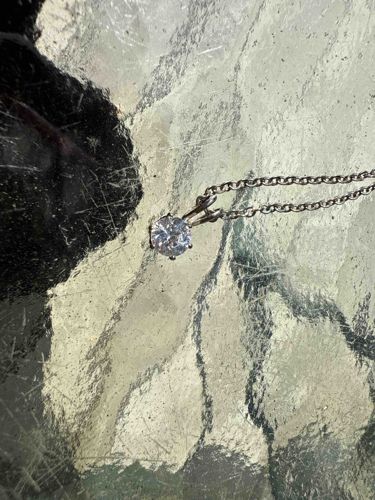
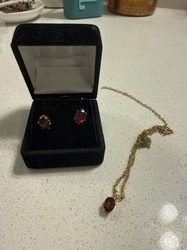
This item is a solitaire pendant necklace featuring a single, round brilliant-cut stone set in what appears to be a four-prong basket setting. The stone, which could be a diamond or a cubic zirconia, exhibits strong brilliance and scintillation, characteristic of a well-cut faceted gem. It measures approximately 4-5 mm in diameter based on visual estimation, suggesting a weight of roughly 0.25 to 0.50 carats if it were a diamond. The metal of the setting and the accompanying chain appears to be silver-toned, possibly white gold, sterling silver, or platinum, given its bright, reflective surface. The chain is an open-link style, likely a cable chain, with small, oval-shaped links. The overall construction appears delicate yet sturdy for daily wear. There are no readily visible manufacturer's marks or signatures from the provided images, so the maker and precise metal content cannot be definitively determined. The condition seems excellent, with no apparent wear, scratches, or damage to the stone or the metal components. The design is classic and timeless, indicative of a contemporary or modern style, likely produced in the last few decades. The craftsmanship appears to be of good quality, focusing on showcasing the central stone effectively.
AI Appraisal Report
I have examined the provided image of this solitaire pendant necklace. The item presents as a classic design featuring a single, round brilliant-cut stone set in a four-prong basket. Based on its visual characteristics, the stone demonstrates strong brilliance and scintillation, suggesting a well-cut gem. Its estimated diameter of 4-5 mm implies a weight of approximately 0.25 to 0.50 carats if it were a diamond. However, without in-person examination and specific gemological testing, it is impossible to definitively distinguish between a diamond and a cubic zirconia (CZ). The silver-toned metal, likely white gold, sterling silver, or platinum, also cannot be confirmed without hallmark verification or metal testing. The condition appears to be excellent, with no visible wear or damage, indicating good care or recent production. The craftsmanship seems solid for a mass-produced item.
Market conditions for solitaire pendants vary widely based on stone type and metal. Given the uncertainty regarding the stone (diamond vs. CZ) and metal content, and assuming a new item or one in excellent used condition, the value is significantly impacted. If the stone is CZ and the metal is sterling silver, the value would be at the lower end. If it were a genuine diamond (0.25-0.50ct) with a white gold setting, the value would be substantially higher. Solitaire pendants are perennially popular, suggesting consistent demand, but the specific material composition dictates rarity and value.
My appraisal value of $50-$250 reflects the high uncertainty. For full authentication and a precise valuation, an in-person examination is crucial. This would involve gemological testing (e.g., thermal conductivity, specific gravity, hardness) to identify the stone, metal testing or hallmark verification for the setting and chain, and a professional cleaning and detailed inspection for any subtle flaws not visible in the image. Provenance documentation, if available, would further assist in confirming origin and quality.