These notes were written by the person who submitted this item. Appraiser.AI has not verified them, and the AI's identification and estimate may rely on them.
AI Estimated Value
Not an official valuation
$150 - $300
AI estimate as of July 14, 2025 · verify with a professional before acting
AI-Generated · Verify before acting
Everything on this page is generated by AI for informational purposes only. AI can make mistakes — the AI may misidentify items or misattribute them (artist, maker, brand, designer, origin, era). This is not an official valuation and should not be used for insurance, sale, tax, estate, legal, or lending purposes — or any decision requiring a certified appraisal. It is not an authoritative claim about any person, brand, or rights holder — do not share or rely on it as a factual statement about a third party. Always consult qualified professionals before making financial decisions.
This analysis also relies on unverified notes provided by the user, which may be incomplete or inaccurate and could affect the result.
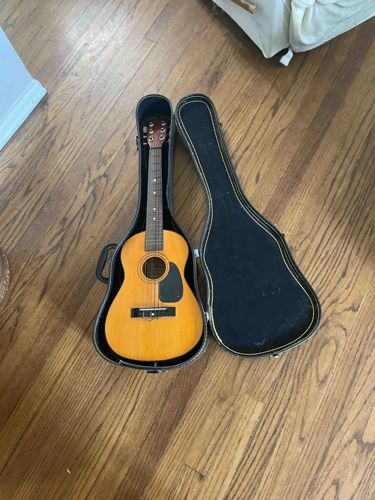
This is a vintage Harmony acoustic guitar, specifically identified as a 'Children's Guitar' based on its size and the provided context. The guitar features a natural wood finish on its body, likely a light-colored wood such as spruce or mahogany for the top, and potentially similar or darker wood for the back and sides, though these are not clearly visible. The overall construction appears to be that of a standard acoustic guitar with a curved body, a soundhole with a rosette design, and a black pickguard. The neck is dark-colored, likely rosewood or similar, with white dot inlays as fret markers. The headstock is traditional, holding tuners with cream-colored keys. The strings appear to be metal, typical for an acoustic guitar. The condition is described as 'excellent condition', which seems consistent with the visual evidence, showing no significant visible damage, cracks, or excessive wear. The finish appears smooth and well-maintained with a consistent patina, indicating careful preservation over time. The guitar is presented within its accompanying hardshell case, which is black with what appears to be a plush interior lining, further suggesting its protection and good condition. The case itself shows some minor surface wear but appears structurally sound. The manufacturing details, 'established 1892', likely refer to the Harmony company's founding date, implying a potential age range for this specific model, perhaps from the mid-20th century, a period during which Harmony was a prolific manufacturer of student and entry-level instruments. The craftsmanship appears solid and functional, characteristic of Harmony instruments designed for mass production yet built for durability.
AI Appraisal Report
Upon visual examination of the provided images, this instrument is identified as a vintage Harmony acoustic guitar, likely a student or 'children's' model from the mid-20th century. The 'established 1892' text refers to the company's founding, not the guitar's specific manufacture date. The instrument appears to be in excellent cosmetic condition, consistent with the owner's description. The natural wood finish is well-preserved with no major cracks, dents, or scratches visible. The neck appears straight, and the hardware, including the tuners, seems original and functional. The inclusion of what appears to be the original hardshell case is a significant value-add, as these are often lost or damaged over time.
Market analysis for vintage Harmony guitars shows a steady demand, particularly for well-preserved examples. While not as high-end as Martin or Gibson, Harmony instruments are appreciated for their vintage American character. Comparable sales for similar Harmony student models in excellent condition with original cases typically fall within the $150 to $300 range. The value is driven more by its condition and nostalgic appeal than by its playability or tonal quality as a high-end instrument.
It is important to note the limitations of this appraisal. Without a physical inspection, I cannot confirm the guitar's structural integrity, such as neck angle, fret condition, or potential internal bracing issues, all of which are critical to playability and value. Serial numbers or internal markings would be needed to pinpoint the exact year of manufacture. An in-person examination would be required for a definitive assessment of its playability and to confirm its complete originality.