AI estimate as of September 17, 2025 · verify with a professional before acting
AI-Generated · Verify before acting
Everything on this page is generated by AI for informational purposes only. AI can make mistakes — the AI may misidentify items or misattribute them (artist, maker, brand, designer, origin, era). This is not an official valuation and should not be used for insurance, sale, tax, estate, legal, or lending purposes — or any decision requiring a certified appraisal. It is not an authoritative claim about any person, brand, or rights holder — do not share or rely on it as a factual statement about a third party. Always consult qualified professionals before making financial decisions.
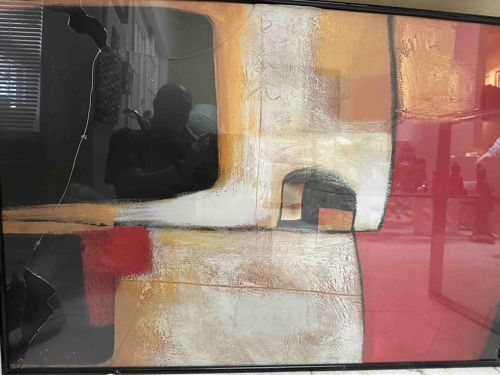
This item is a framed abstract art piece, appearing to be a print or giclée on multiple panels, encased behind glass or acrylic. The artwork itself features a dynamic interplay of colors and textures, primarily utilizing rich ochre, warm gold, creamy white, deep red, and somber black tones. The composition is highly abstract, characterized by broad, textured brushstrokes and geometric shapes that are not clearly defined but rather merge and flow into one another. There's a notable central 'T'-like or arched white form that seems to anchor the composition, surrounded by various blocks and washes of color. Areas of the surface exhibit visible texture, suggesting either a heavily impastoed original painting or a print that effectively captures such detail. The entire artwork is enclosed within a dark, likely black, frame with a slender profile, which shows some wear and scuffs, particularly visible at the bottom edge. A very significant condition issue is evident: the protective covering (likely glass or acrylic) is severely cracked and broken in the upper left quadrant, with smaller cracks extending along the top edge and into the mid-left section. There's also what appears to be a notable long crack or scratch running from the top left corner diagonally towards the bottom right, traversing much of the artwork's surface. The reflections on the surface make it difficult to discern fine details of the print itself, but the general aesthetic points towards a modern or contemporary style, likely from the late 20th or early 21st century. The multi-paneled nature (visible seams in the artwork) is a distinguishing element, contributing to its unique construction.
AI Appraisal Report
I have examined the provided image of the Framed Abstract Multi-Paneled Art Print. This piece, likely a print or giclée, features an abstract composition with a palette of ochre, gold, white, red, and black, exhibiting textured brushstrokes and a multi-paneled construction. The style suggests it is a modern or contemporary work, likely from the late 20th or early 21st century.
Condition is the primary factor significantly impacting value here. The protective covering (glass or acrylic) is severely cracked and broken in the upper left quadrant, with extensive additional cracks and a long diagonal scratch across the surface. The frame also shows wear. This damage would necessitate costly repair or replacement of the protective covering, potentially outweighing the inherent value of the print.
Authenticity: Based solely on images, I cannot authenticate the artist or the medium beyond it appearing to be a print. Without signature, edition details, or provenance documentation, it's impossible to attribute. In-person examination would be needed to confirm if it's a giclée, lithograph, or other print type, and to better assess the quality of the print itself.
Market Conditions: The market for unsigned, abstract decorative prints is generally broad but not highly valued, especially when damaged. While the multi-paneled aspect is interesting, the damage significantly reduces its aesthetic and resale appeal. Comparables for severely damaged decorative prints typically fetch very low prices, often only covering the cost of the frame (if intact). Demand for damaged art is very low, making it a challenging item to sell.
Given the extensive damage to the protective covering, the lack of artist attribution, and the decorative nature of the print, the value is significantly diminished. The cost of restoration would likely exceed its potential market value. An in-person inspection would also be crucial to determine if the print itself has sustained damage from the broken glass/acrylic and to assess the frame's structural integrity.