AI estimate as of October 7, 2025 · verify with a professional before acting
AI-Generated · Verify before acting
Everything on this page is generated by AI for informational purposes only. AI can make mistakes — the AI may misidentify items or misattribute them (artist, maker, brand, designer, origin, era). This is not an official valuation and should not be used for insurance, sale, tax, estate, legal, or lending purposes — or any decision requiring a certified appraisal. It is not an authoritative claim about any person, brand, or rights holder — do not share or rely on it as a factual statement about a third party. Always consult qualified professionals before making financial decisions.
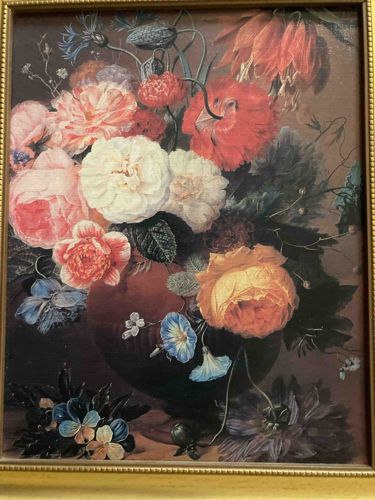
This item is a framed reproduction print of a classical floral still life painting. The print depicts a dense arrangement of various flowers, including large white and pink roses, red poppies or similar large-petaled flowers, orange bell-shaped flowers (possibly Fritillaria), blue cornflowers, blue morning glories, purple and yellow pansies, and other foliage, all gathered in a dark, possibly terracotta or ceramic, vase. The color palette is rich and deep, with vibrant reds, pinks, yellows, and blues contrasting against a dark background, typical of Dutch Golden Age floral still lifes. The print appears to be enclosed in a simple, likely wooden, frame finished in a brushed or antiqued gold color. The frame features a reeded or rope-twist detail along its inner edge. The physical characteristics indicate a mass-produced item rather than an original artwork, given the uniformity of the print texture and the style of the frame. There are no visible condition issues such as tears, significant scratches on the print, or major damage to the frame, although minor scuffs on the frame are possible with age. No specific artist's signature or print edition details are discernible from the image. The style period emulated is likely 17th or 18th-century European, particularly Dutch or Flemish, still life painting. The quality of the reproduction seems good, with a decent color rendition and clarity of detail, suitable for decorative purposes. The craftsmanship of the frame is basic but functional. The composition itself is a common and beloved theme in art history, making this an accessible decorative piece.
AI Appraisal Report
I have examined the provided image of this Floral Still Life Reproduction Print in Gold Frame. Based on my visual assessment, this item is a mass-produced reproduction print, not an original artwork. The uniform texture of the print and the style of the simple, mass-produced gold frame with reeded detail strongly indicate its decorative, non-collectible nature. The condition appears good from the image, with no visible tears or significant damage to the print itself. Minor scuffs on the frame are common for such pieces and would not significantly impact value. Authenticity, in the sense of being an original art piece, is clearly not applicable here; it is an authentic reproduction print.
Market conditions for decorative reproduction prints, particularly floral still lifes emulating classical styles, are generally stable but with low values. Comparables in the secondary market (thrift stores, online marketplaces, estate sales) typically range from $20 to $100, depending on size, frame quality, and visual appeal. Demand for such items is consistent among home decorators seeking an affordable aesthetic, but there is no rarity factor. Its value is purely decorative.
Factors impacting value include its appealing color palette and classical composition, which enhance its decorative utility. However, the print's mass-produced nature and lack of artistic originality or historical significance significantly limit its monetary value. The basic craftsmanship of the frame also contributes to its lower appraisal.
It is crucial to note that this appraisal is based solely on visual examination of the image. While the nature of the item as a reproduction is evident, a physical inspection would allow for examination of print quality more closely, assessment of precise frame condition (minor scratches, chips), and inspection for any hidden markings or labels that might indicate a slightly higher-end reproduction process, although this is unlikely to change the overall valuation category significantly. For full authentication of an original artwork (which this is not), extensive in-person examination, provenance documentation, and potentially scientific testing would be required.