AI estimate as of November 18, 2025 · verify with a professional before acting
AI-Generated · Verify before acting
Everything on this page is generated by AI for informational purposes only. AI can make mistakes — the AI may misidentify items or misattribute them (artist, maker, brand, designer, origin, era). This is not an official valuation and should not be used for insurance, sale, tax, estate, legal, or lending purposes — or any decision requiring a certified appraisal. It is not an authoritative claim about any person, brand, or rights holder — do not share or rely on it as a factual statement about a third party. Always consult qualified professionals before making financial decisions.
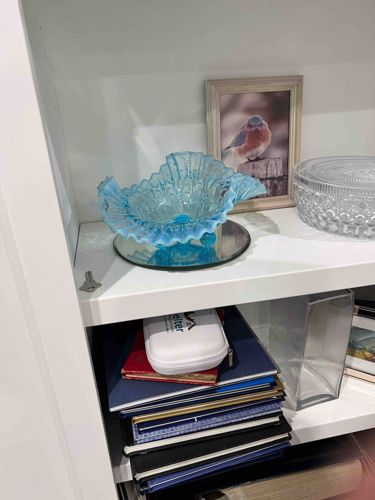
This item is an opalescent blue glass bowl, characterized by its distinctive ruffled and fluted rim. The glass exhibits a translucent quality, appearing lighter blue and almost white at the edges and in thinner areas, gradually deepening to a more saturated, vibrant blue towards the center and base, indicative of opalescent glass. The bowl features a heavily fluted and ruffled design around its entire circumference, with the ruffles creating a dramatic, undulating edge that appears to rise and fall. The body of the bowl below the rim is also ribbed or fluted, adding texture and visual interest. The base of the bowl is not clearly visible, but it appears to be circular and slightly raised, resting on a small, mirrored circular base that is separate from the bowl itself. The bowl's construction suggests it is molded glass, with the fluting and ruffling likely achieved during the blowing or pressing process while the glass was still pliable. There are no readily apparent cracks, chips, or significant damage from the provided images, suggesting it is in good to excellent condition. The surface appears smooth and glossy, consistent with polished glass. The style suggests it could be from the mid-20th century, possibly dating back to the 1940s-1970s, a period when colored and opalescent glass decor was popular. Its aesthetic qualities, including the color and form, suggest it functions primarily as a decorative piece, possibly a centerpiece bowl or a display dish for small items. The craftsmanship appears to be of good quality, with symmetrical ruffles and a consistent opalescent effect throughout the piece. No maker's marks or signatures are visible.
AI Appraisal Report
Based on my visual examination of the provided image, I assess this Opalescent Blue Ruffled Glass Bowl to be in good to excellent vintage condition. The opalescence is evident, with the desirable transition from deep blue to lighter, almost white, at the thinner edges. The ruffled and fluted rim, along with the ribbed body, suggests a mid-20th century manufacturing period, likely from the 1940s-1970s. I see no obvious chips, cracks, or significant damage, which positively impacts its value. The presence of a separate mirrored base is an interesting display choice, though not integral to the bowl's value itself.
Market conditions for decorative colored and opalescent glass from this era are generally stable, with a moderate collector base. Comparable items from well-known manufacturers like Fenton or Northwood, *if* identifiable, would command higher prices. Without a maker's mark, however, it's valued more as an attractive decorative piece. The item's primary value driver is its aesthetic appeal—the vibrant color, opalescent effect, and intricate ruffled form. Demand for such pieces is consistent among those decorating vintage homes or seeking accent pieces. While not inherently rare, the condition and visual appeal make it a desirable item.
Factors significantly impacting value include the absence of a discernible maker's mark and the lack of specific provenance. For full authentication and to potentially attribute it to a specific manufacturer, an in-person examination would be crucial. This would allow for a tactile inspection of the glass quality, examination of the pontil or base for any hidden marks, and a more thorough assessment of its age and manufacturing technique (e.g., pressed vs. hand-blown). Without this, I cannot definitively confirm its origin or specific maker beyond a general vintage decorative glass assessment.