AI estimate as of October 2, 2025 · verify with a professional before acting
AI-Generated · Verify before acting
Everything on this page is generated by AI for informational purposes only. AI can make mistakes — the AI may misidentify items or misattribute them (artist, maker, brand, designer, origin, era). This is not an official valuation and should not be used for insurance, sale, tax, estate, legal, or lending purposes — or any decision requiring a certified appraisal. It is not an authoritative claim about any person, brand, or rights holder — do not share or rely on it as a factual statement about a third party. Always consult qualified professionals before making financial decisions.
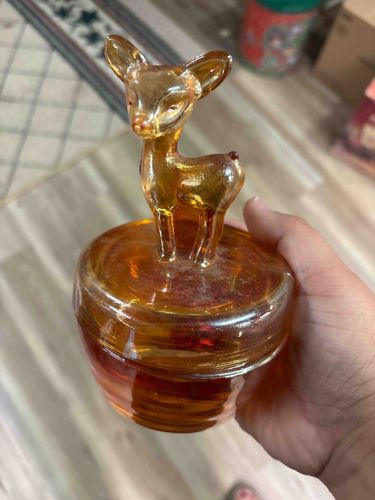
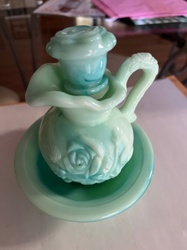
This item is an amber glass trinket box featuring a fawn or young deer figure as its lid handle. The entire piece is constructed from translucent glass, exhibiting a warm amber or marigold color that displays iridescent qualities, particularly under direct light, suggesting it might be carnival glass or have a similar finish. The fawn figurine is detailed with etched eyes, ears, and a slender body, captured in a standing pose with its head slightly turned. It serves as a decorative finial on the round, flat lid of the box. The base of the trinket box is also made of the same amber glass, forming a small, possibly ribbed or faceted container appropriate for holding small jewels or other keepsakes. The overall construction appears to be molded glass, common for decorative items from the mid-20th century. There are no visible chips, cracks, or significant wear evident from the provided images; the surface appears somewhat dusty, indicating that it has been displayed. The craftsmanship is typical for mass-produced decorative glass of its era, focusing on aesthetic appeal rather than intricate hand-finishing. There are no discernible maker's marks, signatures, or stamps visible. The style suggests it could be from the Art Deco or Mid-Century Modern period, likely dating between the 1930s and 1960s, a time when decorative glass figurines and functional trinket boxes were popular.
AI Appraisal Report
Based on my visual examination of the provided image, this amber glass fawn/deer trinket box is in very good condition. I observe no visible chips, cracks, or significant wear. The iridescent quality of the amber glass suggests it might be carnival glass or have a similar finish, common for decorative items of its era. The detailed fawn figurine acting as the lid handle is well-preserved. This piece appears to be molded glass, consistent with mass-produced decorative items from the mid-20th century, likely dating between the 1930s and 1960s.
Market conditions for mid-century decorative glass trinket boxes, particularly those without a known manufacturer or exceptional rarity, tend to be steady but not high. Comparable items, often referred to as 'novelty glass' or 'animal figurine glass boxes,' typically sell in the $20-$75 range, with the iridescent quality adding a slight premium. Demand is moderate, driven by collectors of vintage glass, animal-themed decor, and those seeking functional decorative pieces. Rarity is low to moderate; while this specific design may not be ubiquitous, similar items were produced by numerous glass manufacturers. The lack of maker's marks is a common characteristic for such items and does not significantly detract from value in this price bracket. The absence of documentation or a specific identifiable maker limits its potential for a higher valuation.
To definitively authenticate the type of glass (e.g., true carnival glass versus a similar finish) and confirm its precise age, a physical examination would be crucial. This would allow for closer inspection of the glass composition, manufacturing anomalies, and potential hidden marks. Provenance documentation, though unlikely for an item of this value, would also aid full authentication. However, based on the visual evidence, the current valuation reflects typical market trends for such a piece.