AI estimate as of August 26, 2025 · verify with a professional before acting
AI-Generated · Verify before acting
Everything on this page is generated by AI for informational purposes only. AI can make mistakes — the AI may misidentify items or misattribute them (artist, maker, brand, designer, origin, era). This is not an official valuation and should not be used for insurance, sale, tax, estate, legal, or lending purposes — or any decision requiring a certified appraisal. It is not an authoritative claim about any person, brand, or rights holder — do not share or rely on it as a factual statement about a third party. Always consult qualified professionals before making financial decisions.
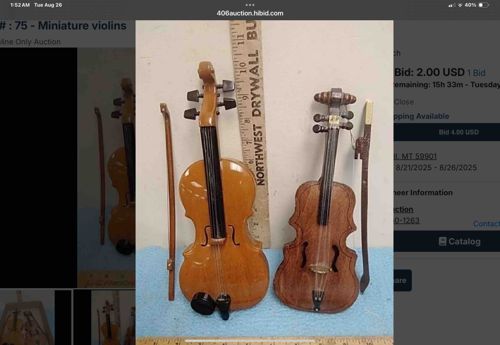
The image displays two miniature violins, each accompanied by a bow, presented alongside a ruler for scale. The violins appear to be decorative or novelty items rather than functional musical instruments, indicated by their diminutive size and the general craftsmanship seen. One violin (left) has a lighter, reddish-brown, glossy finish, suggesting a varnished wood construction, possibly maple or spruce, typical of larger violins, but on a smaller scale. It features black tuning pegs, a black fingerboard, and a black tailpiece. The f-holes are clearly visible, and the bridge is present, though no strings are apparent. The accompanying bow is simple and slender. The second violin (right) has a darker, more rustic appearance with a visible wood grain, possibly walnut or a similarly darker wood, and a less polished finish. Its design is more ornate or distressed, featuring carved details on the scroll and what appears to be a broader bridge. The tuning pegs are also dark. The f-holes are present, but the overall construction seems less refined than the lighter violin. The bow accompanying this darker violin also appears more substantial, with distinctive carving near the frog. Both items show some signs of wear consistent with age or handling, particularly the darker violin which has a more 'aged' look. The presence of the ruler, identified as 'NORTHWEST DRYWALL', confirms their miniature scale, likely under a foot in height. While they mimic the traditional shape of violins, their small size and the lack of visible strings (on the lighter one) or functional details suggest they are primarily ornamental or collectibles, possibly from the mid to late 20th century.
AI Appraisal Report
Upon examining the image of these two miniature decorative violins with bows, I assess their condition as consistent with age and handling for ornamental items. The lighter violin appears well-preserved with a glossy finish, while the darker one exhibits a more rustic, possibly distressed, finish and visible wood grain, suggesting intentional aging or less refinement. Authenticity in this context refers to their identity as decorative objects rather than functional instruments; their diminutive size and lack of apparent strings (on the lighter one) confirm this.
Market conditions for such novelty or decorative musical instruments are generally modest, driven primarily by their aesthetic appeal rather than historical or artistic significance. Comparable items typically fall into the collectible or souvenir category, often purchased for display. Demand is niche; while there’s a consistent interest in miniature collectibles, these specific pieces lack unique identifying features (like artist signatures or brand marks) that would elevate their desirability significantly. Rarity is low as similar decorative violins are commonly produced.
Factors significantly impacting value include their mass-produced nature and absence of high-quality craftsmanship, precious materials, or significant age. Their primary value lies as decorative accents. I estimate they date from the mid to late 20th century.
My assessment is limited without physical inspection. I cannot verify the actual wood types, construction quality, or precise age. An in-person examination would allow for definitive assessment of materials, build quality, and any subtle signs of damage or repair. Provenance documentation, though unlikely for items of this nature, would confirm their origin and history, while scientific testing (e.g., carbon dating for the wood) is impractical and unwarranted given their likely value.