AI estimate as of July 31, 2025 · verify with a professional before acting
AI-Generated · Verify before acting
Everything on this page is generated by AI for informational purposes only. AI can make mistakes — the AI may misidentify items or misattribute them (artist, maker, brand, designer, origin, era). This is not an official valuation and should not be used for insurance, sale, tax, estate, legal, or lending purposes — or any decision requiring a certified appraisal. It is not an authoritative claim about any person, brand, or rights holder — do not share or rely on it as a factual statement about a third party. Always consult qualified professionals before making financial decisions.
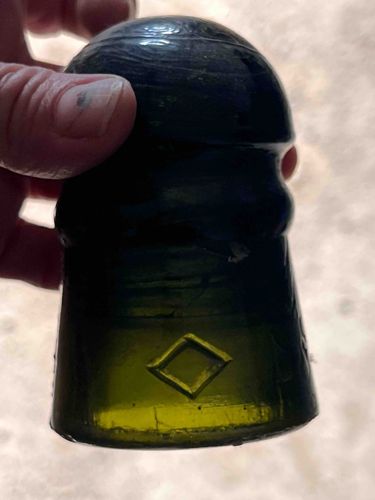
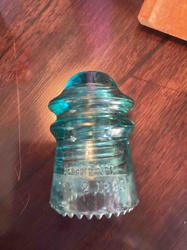
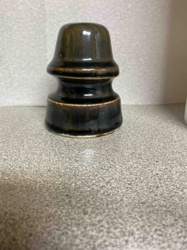
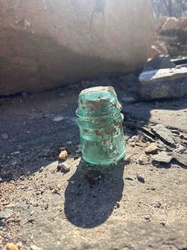
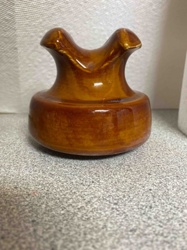
This item is an antique glass electrical insulator, likely dating from the early 20th century, possibly between the 1900s and 1930s given the style and material. It is distinctly colored in a dark olive green or almost black-green hue, with some areas appearing lighter green where light passes through, particularly at the base. The insulator has a classic 'spool' or 'thread' type shape, with a domed top and a series of concentric rings or grooves visible on the upper, round portion, suggesting it was designed to help shed water. Below the domed top, there is a prominent concave band or groove that transitions into a wider, tapering skirt. The overall construction appears robust, typical of utilitarian electrical components of its era. A distinguishing feature is a raised, diamond-shaped marking on the lower, wider skirt of the insulator. This mark is clear and well-defined, suggesting it might be a manufacturer's mark or mold number. The surface shows evidence of age and use, including some minor surface irregularities and what appears to be dirt accumulation or patina, particularly in the grooves. There are no obvious cracks, chips, or significant damage visible, indicating a relatively good state of preservation for its age. The glass exhibits subtle variations in thickness and texture, characteristic of older manufacturing processes. The craftsmanship reflects typical industrial production of the period, prioritizing function and durability.
AI Appraisal Report
Based on my visual examination of the provided image, this antique olive green glass electrical insulator appears to be in very good condition for its age. I see no obvious cracks, significant chips, or large areas of damage, which is a major positive. The classic 'spool' shape, coupled with the distinct olive green hue and the diamond mark, strongly suggests authenticity as a period electrical component, likely dating from the early 20th century (1900-1930s). The variations in glass thickness and texture are consistent with manufacturing processes of that era.
In terms of market conditions, glass insulators are a niche collectible, with value heavily influenced by color, rarity of the specific mold, and condition. Olive green is a desirable color, more so than clear or aqua examples, but not as rare as some of the more vibrant or unusual hues. The diamond mark is a key feature; its specific identification (e.g., a known manufacturer's mark like 'Diamond C' for California Glass Insulator Company or 'Diamond-H' for Hemingray) significantly impacts value. Without knowing the exact identification of the diamond mark, its full impact on rarity is limited.
While demand exists among dedicated collectors, it is not a broad market. This piece's good condition and appealing color make it attractive. Comparables for common olive green units in this condition typically range from $15 to $40. However, if the diamond mark denotes a rare variant or manufacturer, the value could increase, potentially into the $50-$100 range.
My primary limitation in this appraisal is the lack of physical examination. I cannot definitively verify authenticity, check for subtle internal flaws (like stress fractures), or confirm the precise nature of the diamond mark without in-person inspection. Provenance documentation (e.g., history of ownership, original installation site) would also strengthen authenticity and potentially value. Scientific testing of the glass composition could definitively confirm age but is unnecessary for typical appraisals of this type.