AI estimate as of August 4, 2025 · verify with a professional before acting
AI-Generated · Verify before acting
Everything on this page is generated by AI for informational purposes only. AI can make mistakes — the AI may misidentify items or misattribute them (artist, maker, brand, designer, origin, era). This is not an official valuation and should not be used for insurance, sale, tax, estate, legal, or lending purposes — or any decision requiring a certified appraisal. It is not an authoritative claim about any person, brand, or rights holder — do not share or rely on it as a factual statement about a third party. Always consult qualified professionals before making financial decisions.
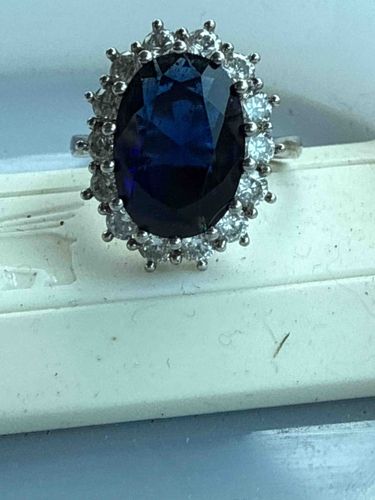
The item is a ring featuring a prominent oval-cut dark blue gemstone as its center stone, surrounded by a halo of smaller, round, clear gemstones. The central blue stone appears to be deep navy blue or sapphire in color, with visible facets indicating a sophisticated cut designed to maximize brilliance and color saturation. Its size suggests it is the focal point of the piece. The halo consists of approximately 14-16 round brilliant-cut stones, which are likely diamonds or diamond simulants, set closely around the primary stone, creating a floral or sunburst effect. The metal setting appears to be white metal, possibly white gold, sterling silver, or platinum, given its bright, reflective surface. The prongs securing both the central stone and the surrounding smaller stones are visible and appear well-formed, holding the stones securely. There is a visible band to the ring on the left side of the main setting, also appearing to be of the same white metal. The overall construction suggests a classic 'cluster' or 'halo' design, reminiscent of jewelry from the mid-20th century onwards, particularly designs popularized in the late 20th century. There are no obvious signs of significant damage like chips, cracks, or missing stones visible from this angle. The metal shows some light surface wear consistent with use, but no major tarnishing or deep scratches are evident. The craftsmanship appears to be of good quality, with stones set evenly and securely. Without further inspection, specific manufacturing marks or an exact age are difficult to determine, but the style points to a timeless design often associated with engagement or cocktail rings.
AI Appraisal Report
Upon visual examination of this Oval Blue Gemstone Halo Ring, I observe a well-maintained piece in good to very good condition. The central oval-cut blue gemstone, likely a sapphire based on its deep hue and facet brilliance, is securely set within a halo of approximately 14-16 round brilliant-cut stones. These smaller stones appear to be diamonds or high-quality diamond simulants. The metal setting is a bright white metal, consistent with white gold, platinum, or sterling silver.
Authenticity of the gemstones and metal cannot be definitively determined from images alone. Without physical examination, I cannot confirm if the blue stone is a natural sapphire or a synthetic/treated gemstone, nor can I verify if the surrounding stones are natural diamonds or simulants like cubic zirconia or moissanite. Similarly, the exact metal composition requires testing. Any claims of authenticity based solely on visual inspection are limited.
Market conditions for halo rings remain strong, particularly for classic designs. Cluster and halo rings with colored center stones are popular, often serving as engagement rings or statement pieces. The demand for blue gemstones, especially sapphires, is consistently high. Rarity would depend on the specific quality and origin of the blue stone and the carat weight/quality of the surrounding stones.
Factors significantly impacting value include the type and quality of the central blue gemstone (natural vs. synthetic, origin, clarity, cut), the authenticity and quality of the halo stones (diamond vs. stimulant, carat weight, color, clarity), and the metal purity (e.g., 14K white gold vs. platinum). Without a physical inspection, specific gravity tests for the blue stone, diamond testing for the halo stones, and metal assays are crucial for full authentication. These tests, along with provenance documentation, would allow for a precise valuation.